Changing the AI-quation: Boost Scale with Agentic Interpretation of Legacy Data

Enterprises are under immediate pressure to scale AI, but they cannot afford to wait years for traditional data integration to catch up, or for outdated cleaning and standardization processes to be completed.
Key Takeaways
- Agentic AI makes legacy data interpretable in real time: Instead of relying on years of ETL and data standardization, AI agents can dynamically understand schemas, semantics, and relationships across fragmented enterprise systems
- Semantic AI enables autonomous decision-making: Agentic entity matchmaking allows AI to connect customer context, products, and business logic in real time — turning raw enterprise data into actionable recommendations and workflows
- Agentic architectures create reusable AI foundations: By building semantic intelligence layers on sovereign, open-source infrastructure, enterprises can scale multiple AI use cases faster, cheaper, and without replacing legacy systems

Together, BCG Platinion and Deutsche Telekom explored whether agentic AI can close this gap by accelerating the process of making legacy data usable. In a joint research and development initiative, the two organizations investigated how agentic AI — autonomous, multi-step reasoning systems — can unlock enterprise data from complex, heterogeneous environments (and transform it into a unified, AI-ready intelligence layer).
Within eight weeks, this collaboration produced a functional prototype: an AI-powered sales cockpit that autonomously interprets customer data, derives real-time product recommendations from live conversation context, and provides AI-assisted guidance for sales agents. The prototype was deployed on Deutsche Telekom's sovereign infrastructure, and built entirely using open-source technology.
When legacy enterprise data is interpreted effectively using agentic AI, the result is a reusable architectural blueprint that proves data is not a barrier to agentic – it is a fundamental raw material.
1. The Vision: Agentic Operating Systems
For decades, enterprise AI has been caught in the same trap - the data needed to make AI useful is locked inside systems that were never designed to share it.
The conventional response to this has been to liberate your data first through ETL pipelines, data warehouses, and master data management – a process that takes years and costs millions. But agentic AI changes this equation.
The old paradigm said: liberate your data first, then build AI on top. Today, organizations cannot afford to wait. Agentic AI changes the equation.
The goal is to become an enterprise that has AI agents operating autonomously across processes: deriving customer context in real time, matching needs to offerings without human search, and acting on insight rather than navigating complexity. While today's organizations deploy large teams to manage data pipelines, the agentic enterprise routes that effort into designing intent, enabling agents to execute at scale.
To make this a reality, legacy data has to be made AI-ready – this means it must be interpreted, not merely transformed. In collaboration with Deutsche Telekom, we set out to prove that this can be done rapidly, cost-effectively, and without replacing a single legacy system. But there are hurdles to overcome.
2. The Context Conundrum
Agentic AI systems are only as capable as the data they can reason over. An agent tasked with recommending the right product to a customer during a live call simultaneously needs a full picture of that customer's:
- Contracts
- Usage patterns
- History
- Available products
- Tariffs
- Campaigns
The agent must also be able to derive a ranked recommendation in real-time based on a transparent rationale, a capability that has to be embedded in the agent’s existing workflow. In telecommunications, and across most large enterprises, none of these inputs are readily available.
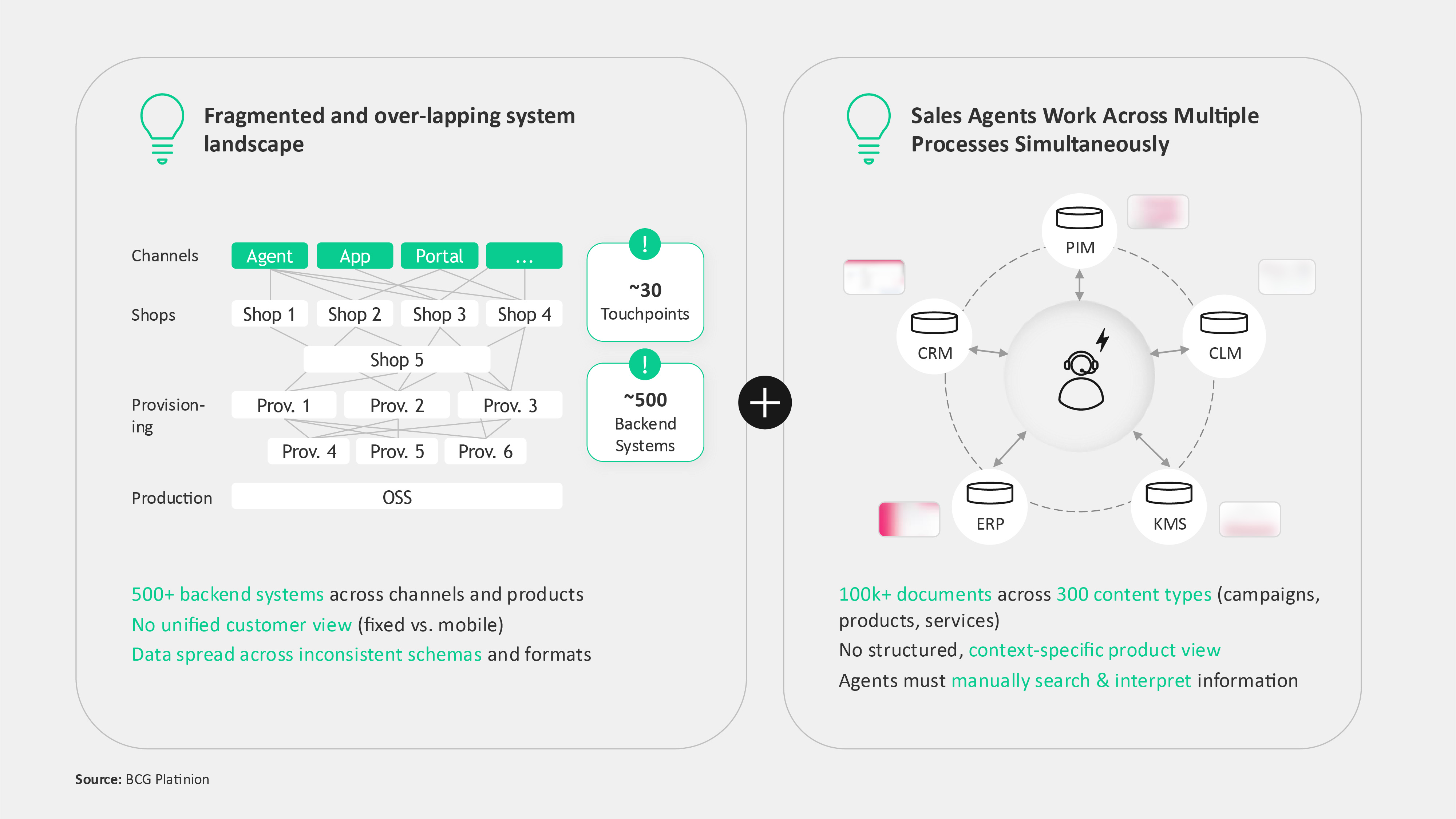
Customer data is distributed across hundreds of backend systems with inconsistent schemas. Product information exists in tens of thousands of documents across dozens of formats. And the business logic connecting customer context to product suitability is implicit (embedded in decades of institutional knowledge rather than any machine-readable form).
AI does not fail because it lacks intelligence. It fails because it lacks context.
This is not a telecommunications-specific problem. Banking, insurance, energy, and any industry built on decades of accumulated IT infrastructure faces the same challenge. The data exists, the value it could unlock is real, but what is missing is an approach that can make it usable for AI - one that doesn’t require a multi-year transformation program first.
3. Why Existing Methods Fall Short
Before describing the approach taken in this initiative, it is worth addressing an obvious question: why can't existing tools solve this?
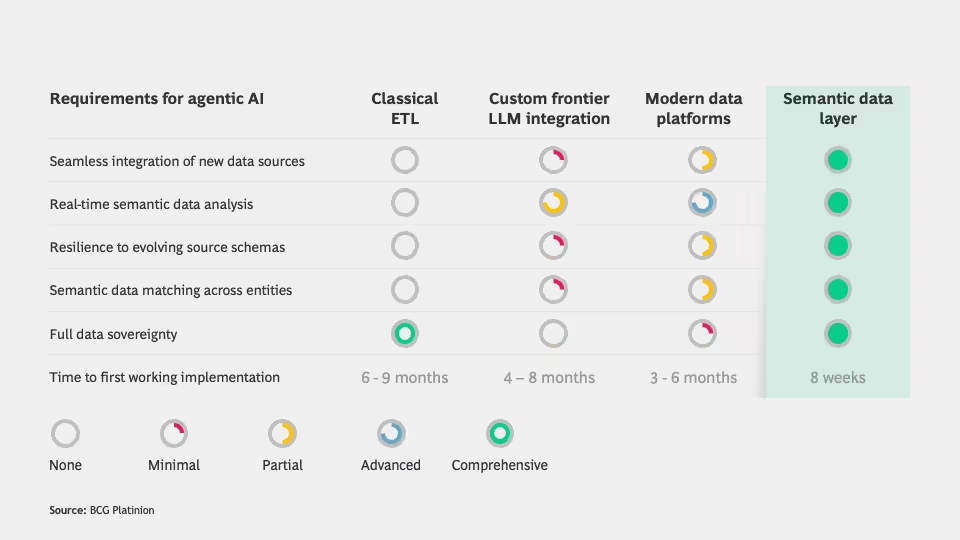
Classical ETL pipelines have served enterprises well in stable, well-documented environments. But they are fundamentally schema-first: they require manually authored mapping rules for every field in every source system.
When schemas change, as they continuously do in large organizations, pipelines break and must be redesigned. They also offer no capacity to interpret undocumented semantics or infer business logic from raw data.
Modern data platforms have made significant strides in unifying data access. Many now offer natural language query interfaces, but they are also schema-dependent, needing upfront configuration, semantic modelling, and data preparation before they can operate effectively. In environments where field names are cryptic, schemas are undocumented, and data quality is inconsistent, this upfront investment is precisely what organizations cannot afford to wait for.
Frontier AI models are genuinely capable of reasoning over data and interpreting ambiguous structures - but a lone model is not a production system. Without a purpose-built agentic layer that handles enterprise integration, multi-step orchestration across sources, governance, and repeatability, frontier models cannot reliably deliver the kind of structured, auditable output that enterprise use cases require.
The table below maps these approaches against the concrete requirements of an agentic AI use case. The pattern is consistent: no existing tool fully covers the real-time context assembly, schema interpretation, semantic matching, and data sovereignty that agentic AI demands.
4. The New Approach: Two Agentic Engines
Rather than attempting to standardize data upfront - the premise behind decades of ETL investment - Deutsche Telekom and BCG Platinion propose a fundamentally different approach: AI agents that interpret data dynamically during processing, rather than transforming it statically in advance.
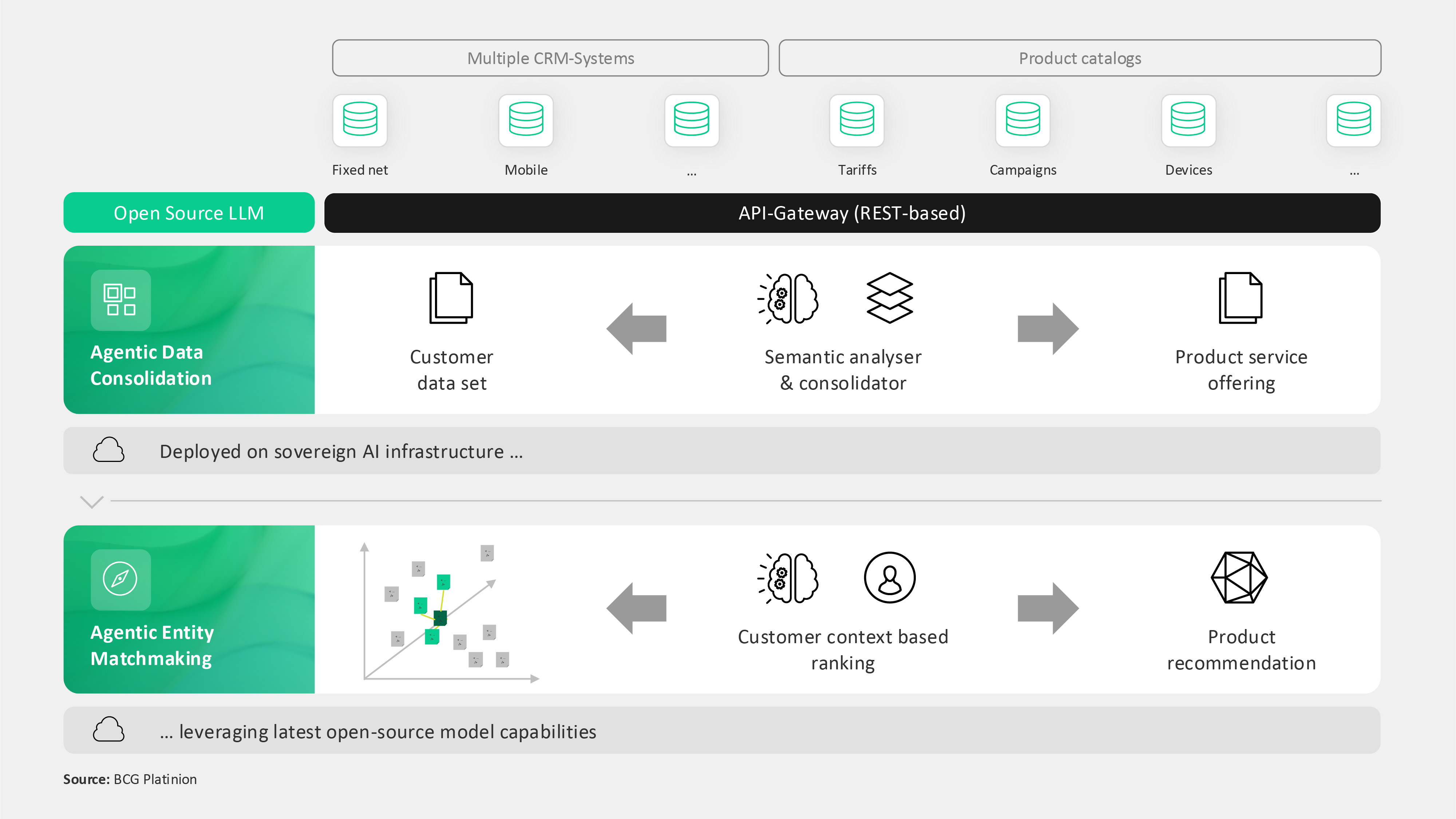
The architecture rests on two complementary agentic components, both built on small, efficient open-source models running entirely on enterprise-owned infrastructure.
Agentic data consolidation: making legacy data interpretable
- The first agent addresses the challenge of data fragmentation. It analyses source data schemas alongside sample records to derive the semantic meaning of each field, interpreting abbreviated labels, identifying entity types, and inferring relationships.
- A second agent uses this enriched understanding to transform raw records from heterogeneous systems into a unified target format, applying data quality corrections and format standardizations as it goes.
The critical difference between this new approach and classical ETL: while conventional pipelines require a human expert to author mapping rules for every field in every source system, the agentic approach interprets data contextually. When source schemas change, the agent adapts through re-interpretation - no pipeline redesign required.
This agentic efficiency has the potential to cut timelines from months down to weeks.
Agentic entity matchmaking: turning unified data into actions
Once data is interpretable, the second component becomes possible. The same semantic understanding used for consolidation is applied to map fundamentally different entity types – from customer profiles to product catalogues - into a shared vector space.
An AI agent can then match a specific customer context against the full product landscape in real time, producing a ranked set of recommendations with transparent reasoning. This is the step that makes agentic AI genuinely useful in a live business process.
The agent does not select from a predefined shortlist or apply manually maintained rules. It evaluates the entire product landscape against the full customer context, and it does so as the conversation unfolds.
Agentic AI does not just process data at high velocity. It derives context autonomously — from a live conversation, a customer record, a product catalogue — and acts on it.
5. The Use Case: AI-augmented Inbound Sales
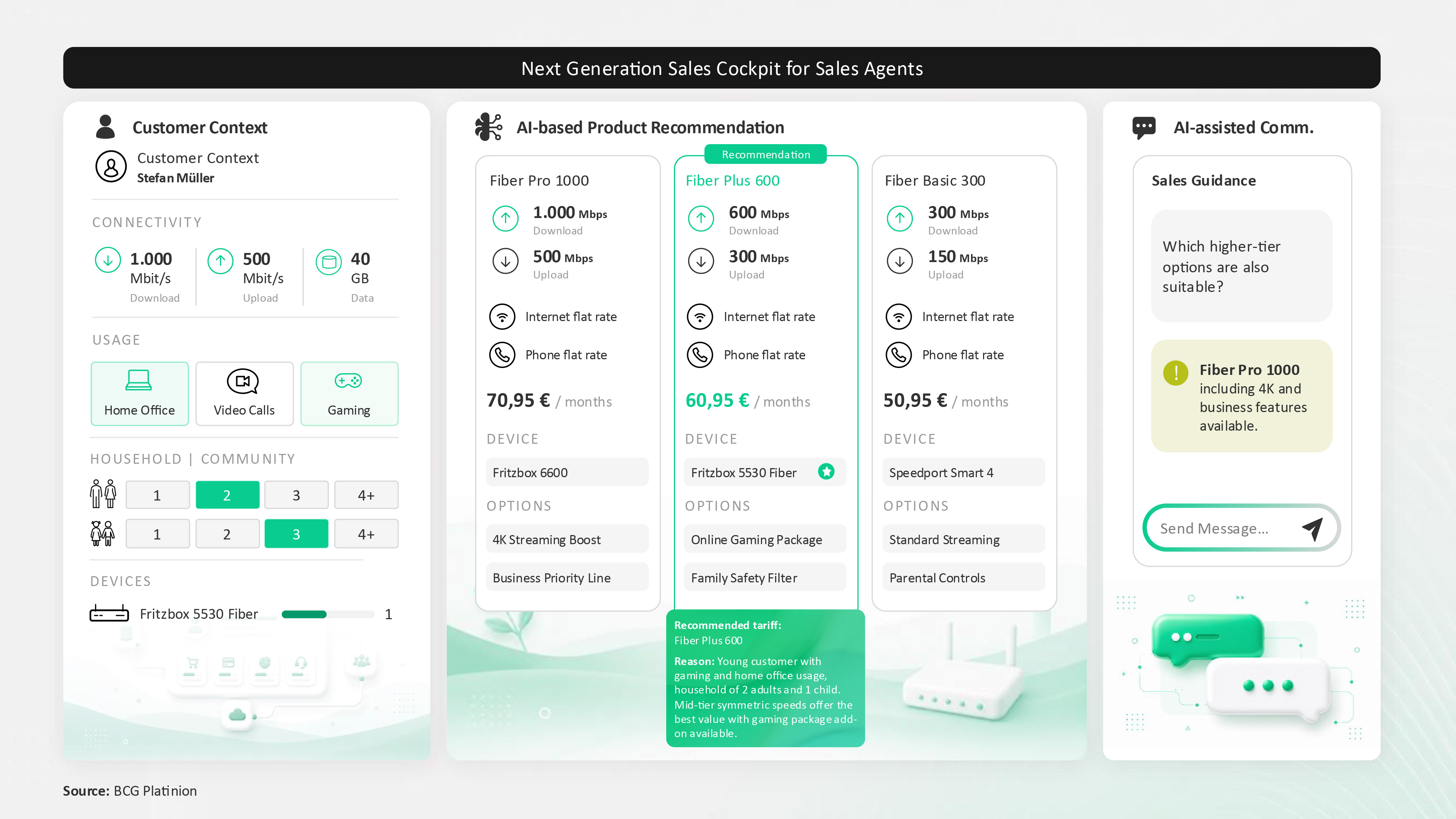
To demonstrate the approach in a concrete enterprise context, Deutsche Telekom and BCG Platinion jointly developed an AI-powered sales cockpit for inbound customer interactions. This is one of the most data-intensive, time-critical, and commercially significant processes in any telecommunications business.
Building on Deutsche Telekom's existing sales cockpit implementation, the agentic AI capabilities developed in this initiative were integrated to bring real-time intelligence directly into the agent's workspace.
Key capabilities:
- A live customer view assembled in real time by the data consolidation agent from across the full source system landscape, presented as a single, coherent data sheet the moment a call begins.
- A ranked set of product recommendations generated by the entity matchmaking agent, which maps the customer's specific context against the full product catalogue. Each recommendation is accompanied by a transparent rationale, explaining what to offer and why.
- An AI coaching assistant that translates these recommendations into clear conversation guidance - context-aware talking points that help agents navigate the conversation from insight to offer.
Together, the three capabilities shift the agent's role from system navigator to trusted advisor, one that acts on AI-derived insights rather than wasting valuable time on information retrieval.
6. Designed for Enterprise Scale
Our architecture was designed with three non-negotiable principles: full data sovereignty, zero disruption to existing systems, and cost efficiency at scale.
The system runs entirely within Deutsche Telekom's infrastructure on self-hosted open-source models, avoiding any dependency on external model providers and ensuring that no data leaves the organization. It connects to existing systems through standardized APIs, leaving the underlying IT landscape untouched. And it relies on small, specialized models (rather than large, general-purpose ones). As a result, the system is purpose-fit for the task and significantly cheaper to operate.
Cost effectiveness was not the only reason we opted for open-source models, they also enable the organization to fine-tune, audit, and evolve its AI components independently. This is critical in a regulated industry where transparency and control are non-negotiables.
Within eight weeks, these principles were translated into a functional prototype. This execution speed is not merely an operational detail, it highlights the fundamental advantage of the agentic approach. By eliminating the months-long ETL phase that traditional data integration requires, the time from concept to working system compresses dramatically - from a multi-year program to a sprint.
7. From Complexity to Meaning
The initiative demonstrates that agentic AI can unlock value from complex data environments at a speed and cost that traditional methods cannot match. Importantly, it does so without requiring organizations to solve their data problem before deploying AI – solving it becomes part of the AI solution.
Any organization, from banking to energy, built on decades of accumulated IT infrastructure faces some version of the same problem. The agentic data consolidation and entity matchmaking offer a proven path forward for any organization looking to turn its existing data landscape into a competitive advantage (without waiting for a lengthy transformation program to complete).
Looking further ahead, the semantic intelligence layer built in this initiative is not a single-use solution. It is a reusable foundation, one that each new agentic use case can build on - as more use cases are added, the value of the foundation compounds. This is the architectural logic of an agentic operating system, one that grows more capable as the data it reasons over becomes richer and more connected.
Ultimately, agentic AI has the potential to create a reusable architectural blueprint that transforms how enterprises operate. But realizing this potential requires more than deploying capable models. It requires making enterprise data interpretable, not through years of upfront standardization, but through AI systems that can derive meaning from complexity in real time.
Deutsche Telekom and BCG Platinion have demonstrated that this is achievable, even in one of the most complex IT environments in European industry - and that it can be achieved rapidly.




.png)
.jpg)