Flex-ready Utilities: Six Foundational Factors

How do utilities build a profitable flexibility business? This article breaks down the six operational dimensions, from AI-driven forecasting to zero-touch onboarding, that separate scalable flex from stalled pilots.

Within the decade, it is estimated that the connected load generated by household heat pumps, electric cars, and solar batteries will increase tenfold – rising from 20 GW[1] in 2020, to over 200 GW by 2030.
As peak load and grid pressure concerns grow, decentralized flexibility – the ability to optimize how and when assets like EVs use or generate electricity – has entered the spotlight. It helps ensure grid resilience, satisfy demand, and strengthen customer relationships, presenting a €58 billion a year opportunity.
In our previous article, we explored the six key factors associated with true flexibility readiness, and how utilities players can translate them into an execution roadmap:
- Operating model
- Capabilities
- Architecture
- Scalability & automation
- Security & resilience
- Data & integration
This article highlights the specific capabilities utilities need to facilitate decentralized flexibility and scale it sustainably.
1. The ideal operating model
Turning flexibility into repeatable P&L should be approached in the same way as mission-critical trading infrastructure. Adopt 24/7 Flex Ops, Site Reliability Engineering grade practices, model governance, and a clean RACI covering trading and billing (and assign ingest-forecast-bid-dispatch-settle KPIs).
Prioritize these four operating model components:
- Organisational structure and teams. Implement a 24/7 Flex Ops function with run books, and tether SLOs and SLAs to the ingest-forecast-bid-dispatch-settle chain. Utilities need to be clear on the energy trading tech stack and risk management (ETRM) adapters, as well as customer portals, market access, and who owns the VPP (or the logic that aggregates and optimizes assets).
- Commercial mechanisms, billing, settlement. This is about putting the commercial mechanisms in place to transparently split value with customers and reconcile profits. Dynamic tariff models, value-sharing schemes, and the back-allocation of realized volumes are central to this.
- Service providers and sourcing. Establishing a vendor strategy ensures responsibilities are clearly understood, and maintaining a clean RACI is the way to do it. Knowing who certifies reserves and who maintains market adaptors is vital.
- Cost and efficiency levers. The ability to track costs at a granular level is the key to scaling profitably in the flexible energy era - that means monitoring costs per megawatt (MW) and per asset.
On the subject of granularity and precision, successful flexibility trading hinges on the effectiveness of your forecasting and optimization capabilities. Ultimately, the amount of money settled is the only metric that matters.
2. Capabilities
Buying or selling electricity at the best possible time (in the best possible market) demands continuous, real-time monitoring of live telemetry and market data. It also calls for continuous calculation of the tradeable flex band, and a dynamic view of asset-level marginal costs to inform effective bid decisions.
This is where AI-driven forecasting and optimization comes in. Prices, congestion levels, grid constraints and customer behaviours change rapidly and constantly, making asset availability challenging to predict. Changing weather patterns add to the challenge, influencing both demand and renewable output.
Flexibility trading capabilities:
- Availability and behaviour forecasting – examples include EV plug-in times, heat pump duty cycles, battery state of charge (SOC).
- Price forecasting – including day-ahead (DA) curves, the intraday (ID) market microstructure, and reserve prices. Activation probabilities and the marginal cost logic underpinning bidding decisions (e.g. reimbursing households for curtailed rooftop PV generation) must also be taken into account.
- Portfolio optimization – multi-asset, multi-market decisions must be made without small, compounding errors impacting operational limits or customer comfort.
- Real-time re-optimization – ID trading in many EU markets is continuous, and market positions need to be updated in real-time. Deviations between scheduled and actual consumption have to be addressed to prevent imbalance.
Monitoring fills and dispatching assets continuously is crucial, and every trade must be written into the ETRM. Conducting back-allocation and converting portfolio-level trades into per-asset economics are also top priorities.
3. Architecture
A modular, cloud-native system design is essential for handling the sheer diversity of devices in use today – but also for achieving real-time control and market-grade reliability.
An effective architecture needs to decouple devices by connecting them via standard interfaces, so that adding and altering devices doesn’t impact the wider system. Integration with wholesale markets also requires the freedom to evolve independently of changing rules, products, and geographic factors.
Protocol agnostic adapters have an important role to play, with prime examples including OpenADR, OCPP, IEC 61850, MQTT, and REST. These adapters allow a wide variety of devices to be accommodated and rapidly onboarded (while avoiding vendor lock-in). A flex-ready architecture will integrate cleanly with DSO and market platforms, ensuring secure bid submissions, settlement workflows and dispatch instructions. By implementing network-aware, geographic routing, precise flexibility delivery can be achieved.
Event-driven architecture is the key to scale, making it possible for utilities players to manage millions of telemetry points and dispatch signals per second with low latency.
4. Scalability & Automation
The goal is to automate and harden your process simultaneously. This means eliminating manual chokepoints, encoding low-touch flows, and making the stack resilient enough to scale MW without scaling headcount.
Tomorrow’s utilities leaders are shifting from manual enrolment to zero-touch device onboarding, and from analyst-driven optimization to auto-bid and auto-dispatch. Moving from a dashboard-only approach to proactive alerts and self-healing runbooks is key.
MW potential will be capped without sufficient automation and resilience, and a single market event could wipe out months of goodwill and P&L. Future leaders in this space will treat ops and SRE for flexible energy like mission-critical trading infrastructure.
5. Security & resilience
End-to-end security by design is essential in the era of flexible energy platforms, with millions of endpoints and signals to protect. Sophisticated IoT security capabilities and encryption are key to controlling access.
At the platform level, utilities should adopt a risk-driven, standards-based cybersecurity architecture, built on zero trust principles, continuous monitoring, anomaly detection, and role-based access control. Security measures should be designed to ensure full compliance with current regulation, and be adaptable to future requirements.
Top controls for security and resilience:
- End-to-end device and cloud security, including TLS, cert pinning, RBAC, secure firmware, and strong authentication for device, cloud, and market links.
- Fail-safes to prevent unsafe dispatch, with throttling and graceful degradation capabilities in place for when signal or telemetry drops.
- Critical infrastructure compliance and disaster recovery procedures, tested against real-world failure modes (e.g., a communications outage during a system-stress day).
- Measurement, verification, and settlement that you can audit - baseline integrity and dispute workflows reduce payment friction.
- Continuous testing and improvement, including regular penetration testing, control validation, incident simulations, and periodic architecture reviews to maintain best-in-class cyber resilience and regulatory readiness.
Flexible energy systems must be designed with fail-safes built in, ensuring that assets revert to predefined local settings and behaviours if connectivity is lost. Automated failover and disaster recovery plans maintain continuity in the event of outages.
6. Data & integration
With a dedicated integration layer in place, connectivity can be managed effectively, data can be normalized efficiently, and control can be orchestrated across ecosystems.
This crucial layer is where real-time telemetry data is ingested from smart meters, IoT cloud platforms, home energy management systems (HEMS), and third-party aggregators. The goal is to translate this raw data into standardized signals and derive dispatchable resources from distributed assets.
Flexibility readiness hinges on the sophistication of a utility player’s data management capabilities. Those able to conduct data validation, time-synchronized measurements, and lineage tracking can continuously improve dispatch performance, customer experience, and economic outcomes.
Interoperability is a top strategic advantage. By abstracting the device-specific logic behind interfaces, utilities are able to integrate new assets and partners without having to redesign core systems. A scalable data platform makes this plug-and-play approach more feasible, while maintaining performance, governance, and compliance.
[1] Short Study: The Value of Decentral Flexibility
Flexibility across the value chain
Innovative utilities will monetize flexibility at scale. This means managing flex across the entire value chain end-to-end – from onboarding customers to settling benefits.
A coherent flex strategy doesn’t just bolt flexibility onto existing processes; you need to consider:
- Onboarding – Decide which customers and asset types (PV, batteries, EVs, heat pumps, etc.) you want in your flex portfolio, and select a tariff logic. Design a simple journey for identification, consent, device registration and connectivity, and clarify who owns the customer relationship when aggregators are involved.
- Aggregation – Ensure you can reliably connect to and control assets, forecast their availability, and qualify usable flexibility.
- Optimization & Trading – Aggregate assets into a portfolio or virtual power plant, and make sure optimization and trading functions turn this portfolio into concrete products and bids for the right markets (Day-Ahead, Intraday, Ancillary).
- Measurement & Settlement – Trace which customers or assets deliver flex and when, calculate the monetary benefit (including pooling and portfolio effects), and return it transparently via billing, rebates or dynamic prices.
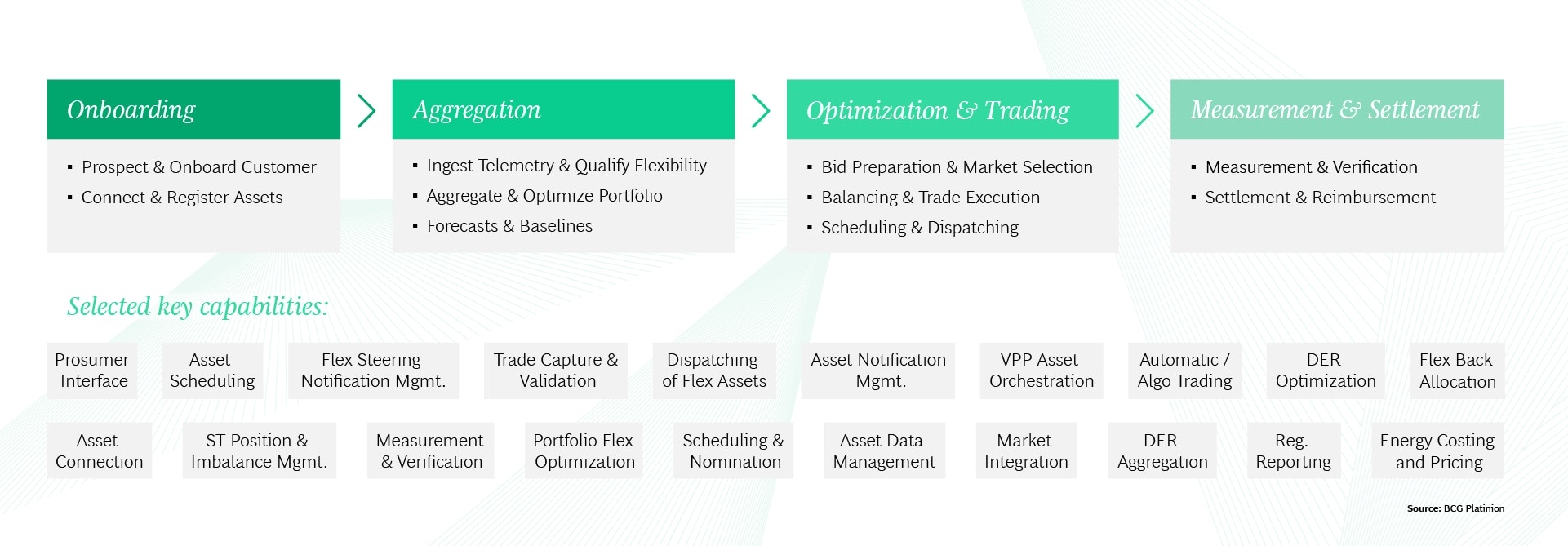
Successfully achieving flex at scale across the value chain means overcoming challenges, like reliably aggregating decentralized assets, operationalizing new tariffs, and value-sharing. Coping with high-frequency trading and settlement volumes, and modernizing legacy system interfaces, are also key hurdles to address.
To find out how BCG Platinion helps leading utilities prepare for the flexible energy future, get in touch with our experts!