Four Urgent Questions for CIOs as AI Reshapes Every Function

CEOs are rebuilding their companies with AI — as CIO, are you ready to lead a boardroom conversation about the architecture that will make it all possible?
Key Takeaways
- The AI reshape is now a board-level obligation, not a pilot program. CEOs are committing to multi-year transformation plans across finance, procurement, HR, and supply chain — and increasingly turning to the CIO to determine what's possible.
- Most reshapes do not stall because agents fail, but because the underlying systems weren't built for them. Fragmented core data, systems designed for human clicks rather than machine-to-machine interfaces, and security models that fail to identify agents as actors are the real blockers — not the AI itself.
- Major platform vendors are no longer interchangeable. Distinct bets are being placed on how the agentic era will play out, forcing CIOs to choose a curated, governed ecosystem or an open, multi-vendor platform — rather than assembling a stack piecemeal.
- Four questions determine whether a reshape can scale: a single agreed version of core information, systems designed for agent use, a named core-systems vendor strategy, and a defined agent identity model within the security framework.
- The competitive window is closing over the next 18 months. The gap between companies that commit now and those that hesitate will show up in margins, cycle times, and valuation — and vendors' agentic capabilities are shipping faster than most company roadmaps can absorb them.

Tomorrow’s industry leaders are already engaged in AI transformations. CFOs are building finance functions that close in days rather than weeks, with financial forecasts that update in near real time. COOs are establishing supply chain systems that are resilient and respond faster than any human team, and CHROs are eliminating the administrative burden by leaning out traditional talent operations.
But the outcomes of these objectives depend on the NextGen Architecture that underpins them, and CIOs must have answers to several critical questions — ranging from data to design to deployment.
Answering these questions is not simply an IT exercise. CIOs today, more than ever, are expected to sit alongside the CFO, COO, and CxOs as partners in enterprise value creation — equally accountable for revenue growth and creating competitive advantages. There is an immense opportunity for CIOs to take the stage and lead their enterprise to the next frontier through AI innovation —the right AI strategy creates first-mover advantage; the wrong one erodes value by committing capital that could have been invested toward asset development elsewhere in the organization.
Data as an asset used to be a differentiator; today it is table stakes for any CIO, and the differentiator is where, and how aggressively, you deploy AI to achieve business outcomes.
In this article, our experts help equip you to become an authority on AI.
1. The reshape is a reality
Across large industrial and consumer goods companies, boardroom conversations have shifted away from what AI “could do for our industry” and toward the question of “how can we reshape faster than our competitors?”
“The reshape is no longer hypothetical. The only question is whether you will lead it, or absorb it from competitors who moved faster.”
Many CEOs are rolling out multi-year transformation plans that feature:
- Demand-sensing agents that continuously update commercial plans based on channel inventory, weather, social signals, and competitor moves (enabling CMOs to run small teams focused on judgment).
- B2B sales agents that autonomously negotiate contract renewals and re-run pricing, optimizing revenue by reviewing market demand in real time, driving gross margin improvements and gains in working capital.
- Procurement agents that enhance the supply chain by running indirect spend end-to-end, allowing buyers to shift from transactional work to supplier management and COOs to compress cycle times by half.
- HR agents that handle screening, scheduling, onboarding, and case management, while the CHRO redirects human capacity to talent strategy and culture.
- An AI-enabled finance function that reduces month-end close to just two days, updates forecasting hourly rather than quarterly, pressure tests M&A scenarios in near real time and steers the business.
Every one of these AI ambitions is achievable, with major platform vendors having shipped significant agentic capabilities in the past 18 months — including SAP, Oracle, Salesforce, Workday, and Microsoft. Pilot projects launched by early adopter companies are already achieving results.
As more CEOs recognize that the AI reshape is now a board-level commitment and not just a vision document, they will turn to the CIO first to understand what is possible.
2. Systemic stumbling blocks
The main reason AI reshapes stall is because the operating models and systems that run the company were not built to support a full AI transformation. Vendor demos always work; single-function pilots in areas like customer service usually do, but then the progress stops. It does not stall because the agents fail — it stalls because the company underneath them was built decades ago for human-led transactions, not agentic-led ones.
“Most CEOs underestimate how much of the reshape is actually a question for the CIO. It does not stall at the agent. It stalls because of the company.”
Information lives in too many places, with companies running finance, planning, procurement, supply chain, and HR across multiple systems (provided by different vendors). Each holds its own version of “the customer” and comes with sets of specialist tools. A single agreed version of your core information is vital. A human can paper over such gaps, reconciling in their head and absorbing the errors that creep in, but an agent cannot — and at machine speed those errors compound. Master data management was the first answer and remains necessary, but it is no longer sufficient. It harmonizes the records, but it does not make them readable, actionable, and trustworthy for an agent operating across systems without a human in the loop. Until an agent can act on a single version directly, the reshape will fragment at every cross-functional boundary.
Your core systems were built for people, not agents. Humans clicking buttons were the original users, but agents read information, execute processes, and close transactions via machine-to-machine interfaces. Trying to maintain outdated systems by taking a project-by-project approach only results in each agent costing as much as the first.
Security systems that do not recognize agents as actors. When a human posts a journal entry, there is an audit trail, an approval chain, and an authorization. But who owns the entry when an agent posts one? What permissions were used? Who responds to the auditor? Until these points are addressed, a reshape cannot survive its first internal audit.
Most CEOs overlook these pitfalls until they are over a year into the process, and there is no time to lose.
3. The competitive window is closing
Over the next 18 months, the gap between the companies that have committed to the reshape and those that hesitated will become visible — in terms of margins, cycle times, talent intensity, and valuation multiple.
The core systems vendors’ release cycle is also faster than your roadmap. Major players like SAP and Oracle now ship new agent capability every quarter, but a decades-old core will need dedicated, foundational retrofit work first. For those yet to act, the gap is getting wider every quarter. A modern, well-designed core absorbs each release in days; the retrofit is the price of a heavily customized, 20-year-old core.
Most importantly, major platform vendors are no longer interchangeable, with each pursuing its own agentic strategy. These are not different variations of the same product; they are differing bets on how the agentic era will play out, and you can only commit to one direction at a time:
- Salesforce has opened its agent platform to multiple frontier model providers and positioned itself as the orchestration layer and data backbone across customer-facing and operational workflows.
- SAP has focused on its own stack, with agent capability designed to perform best on a clean S/4HANA core with SAP’s own data fabric underneath.
- Oracle is bundling AI agents into its applications and pairing them with infrastructure economics, including an OpenAI partnership routed through Oracle Cloud.
- Microsoft is betting on Copilot itself, building it into every M365 and Azure tool a company already runs, so agent adoption feels like flipping a switch, not buying new software.
Using these platforms interchangeably would result in a stack that inherits the worst of each, so two broad archetypes are emerging:
A curated ecosystem, whereby the organization leans on a primary ERP vendor that delivers AI via a tightly governed, enterprise-grade environment. This route prioritizes compliance and reliability over flexibility, signaling a tightly integrated option more akin to Apple than Android, for example.
An open platform model that exposes data and workflows to external AI agents and orchestration tools, accepting more heterogeneity in exchange for faster experimentation and greater reach. This is the Android route.
Neither archetype should be viewed as a one-way door, however. Committing to a direction is not the same as committing to a single vendor's roadmap forever — and treating it that way is how CIOs end up locked into a narrow set of AI capabilities just as better ones, or better partnership terms, become available elsewhere. The goal is to choose deliberately while preserving room to pivot: negotiate data portability and exit terms up front, avoid multi-year exclusivity on unproven agentic capability, and keep a live line of sight into what alternative vendors and partners are shipping. Optionality preserved early is cheap; optionality clawed back after a deep partnership is established and certain routes to innovation are unavailable, is not.
The right choice depends on your industry, risk tolerance, and how far you intend to take the transformation. The decision must be made explicitly, and deferring it tends to be a mistake. Assembled bottom-up, tool by tool, without a top-down direction, a stack inherits the integration debt of every choice and leaves your AI strategy captive to whichever vendor you happened to pick first. And if the decision sits one level down, the CEO will not realize the choice has already been made.
4. The four critical questions
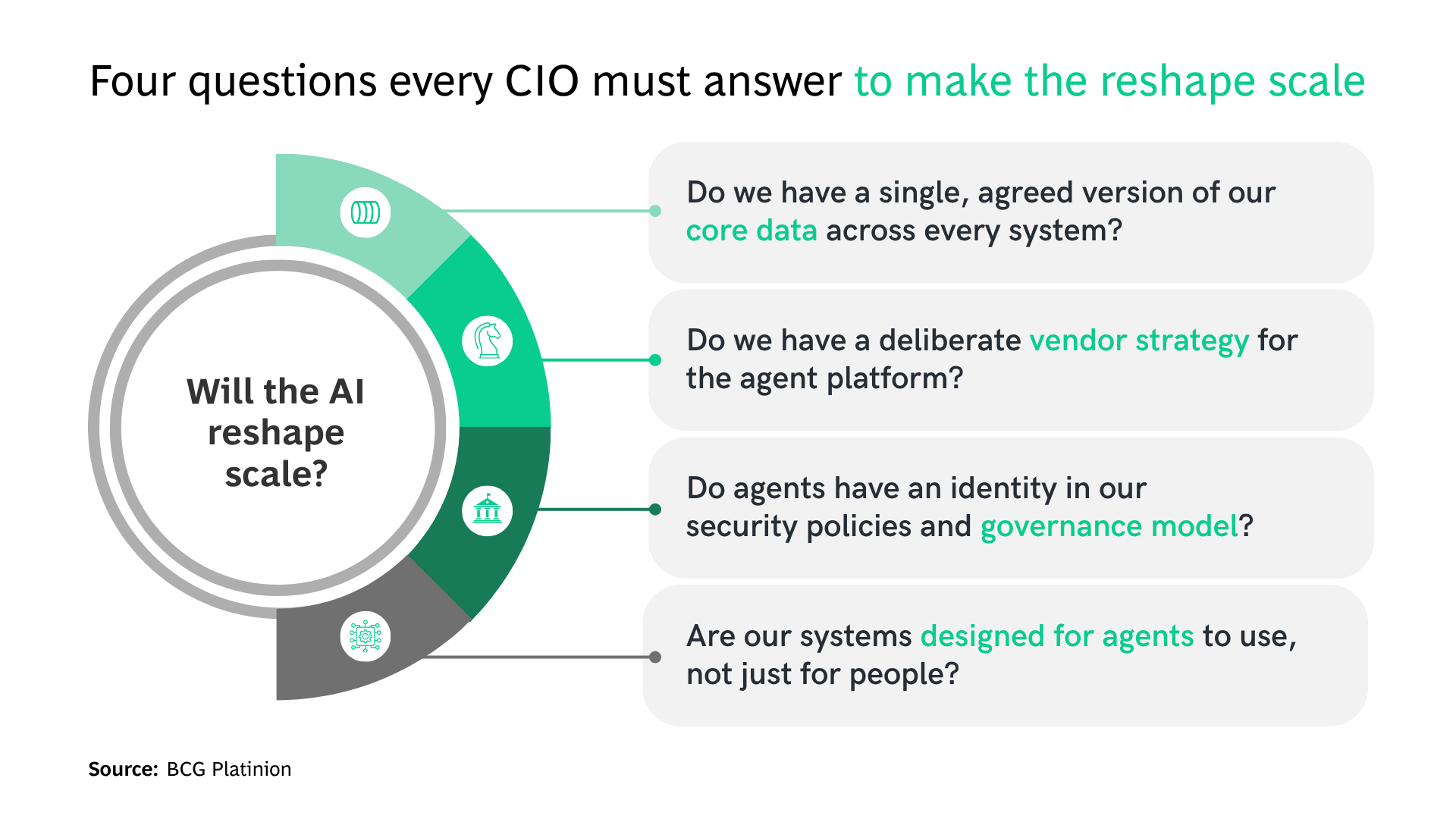
The reason these questions are critical is that they define what needs to be fixed:
- Do we have a single, agreed version of our core information across every system? A specific, funded program should be in place that closes within 12 months, spanning customers, products, suppliers, profit centers, cost centers, employees, and projects.
- Are our systems designed for agents to use, not just people? A CIO needs to be able to tell their CEO that a deliberate architecture decision has been made (or is about to be) that will expose systems for machine use by design. There is a deeper prize here. Much of how your company actually makes decisions isn't situated anywhere permanent — it exists in people's heads and scattered satellite systems, not in the ERP. Systems built for agents to both read and write turn that tacit company memory into something agents can draw on and add to, which is where compounding advantage starts.
- Do we have a core systems vendor strategy for the agent platform? A named strategy with explicit rationale is required, whether it is a custom build or a system delivered by a major vendor. Without clarity, vendor management issues will arise within two years. A strong solution is built from three prior judgments: what kind of business you are (a diversified portfolio tolerates more heterogeneity than a focused single-product company), whether your edge is being nimble or operating at scale, and whether you explore the ecosystem broadly or place one concentrated bet — then pressure-tested against where each vendor is heading. The strategy should be judged, in part, on whether it preserves optionality and flexibility for accretive partnerships and new capability as they emerge. A vendor choice that locks your enterprise into a single ecosystem is exactly the kind of choice this goal should rule out.
- Do agents have an identity within our security model? The right answer is that a defined agent identity model is in place, or that there is a funded program to build one within the next six months. If you have not yet framed this as an architecture problem distinct from “users” and “system integrations,” it is the single highest risk gap in the reshape.
When a CIO has clear, robust answers to these four questions, a reshape can scale. Without them, the company spends the next two years catching up with more proactive competitors. To see what those answers look like in practice, start where they show up first — Finance.
5. What good looks like: Finance first
The four questions are abstract until you watch them play out in a single function. Finance provides the proving ground because it is where the multi-system reality is most visible. The architectural decisions that have a positive impact here will be the ones that enable marketing, supply chain, and HR to follow suit.
To make this concrete: the Head of FP&A’s first task is no longer to open the planning system, but to review what agents did overnight. It means variance flags, draft commentary, and scenarios re-run against fresh market signals. They review, judge, and escalate, but do not write. Month-end close runs in two days instead of 10, the rolling forecast updates continuously, and a team of 30 does work that used to need 100. None of the major vendors will harmonize the finance core, planning tool, consolidation engine, data fabric, and agent layer for you — that is the CIO’s to own.
The board will easily be able to see the positive results achieved across the finance function because they are the most measurable and require no translation. Every other AI reshape can subsequently follow the same proven pattern.
Following the instinct to run an AI pilot for HR scheduling or CRM may build confidence, but not a foundation. The companies we see pulling ahead are those that have committed to building foundations early and at the core ERP level.
6. Sequencing the decision
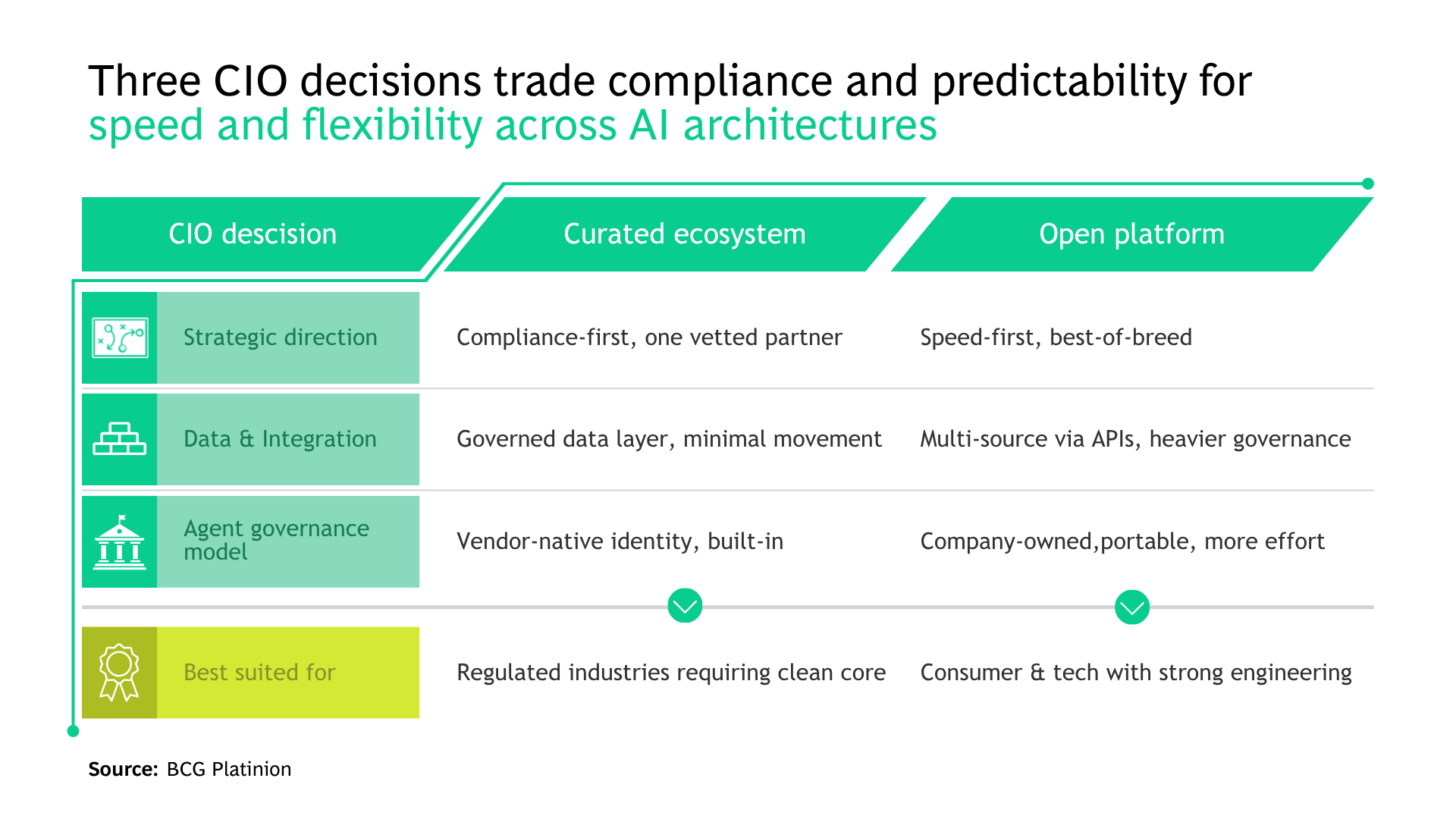
Acting on the above four priorities in the right order for your organization is key to maximizing scale and returning value on the investment. To determine the right sequence, there are three steps:
Set your strategic direction deliberately. Your primary ERP commitment and the archetype on top of it are one decision, not two — your ERP commitment is your archetype bet: a curated, governed core, or a more open one. If the core is due to be selected, choose that direction deliberately; if you are already wall-to-wall with one vendor, you inherit the archetype they drive and must plan around it.
Fix your data and integration foundation by establishing a sole source of master data truth and prepare your core systems for machine consumption. At this stage it is time to assess whether you need a data fabric, lake house, or direct API access to make your data agent readable. Increasingly, modern LLM-based agents can consolidate, transform, and reconcile across systems without moving the data. Designing for this from the start avoids building a warehouse you will later regret.
Build your agent governance model. Define agents as first-class actors in your security and compliance model, fully equipped with authorization scopes, audit trails, escalation paths, and accountability ownership. Build it once and it can be applied to every agent deployment that follows; skip it and there will be a gap in your first internal audit (or an agent error at scale). This is not an IT security question; it is a governance question requiring input from the CFO, General Counsel, and COO.
The table below maps these three steps against the curated ecosystem and open platform archetypes, providing a way to understand the strategic logic of each path.
The decisions to make now
Strip the reshape back and it comes down to a handful of decisions the CIO must force to the C-suite, not absorb alone. Lock the four questions as funded commitments, not aspirations. Fix your position on the curated-to-open spectrum — chosen deliberately if your core is still to be selected, understood and planned around if you are already committed — because that direction governs every product decision that follows. And sequence them in that order: direction, then data and integration foundation, then finally agent governance.
This is an ongoing series of decisions that should form a strategy. Vendor bake-offs, partnership agreements, and alliance terms deserve the same regular revisiting — not defaulting to whichever vendor won the first comparison, and staying genuinely open to new entrants as the field keeps shifting. The drive to create ongoing agility connects back to the goal; the CIO's mandate is still to drive business growth, and agility is simply what lets the AI agenda keep finding incremental gains.
Two further moves belong in front of the C-suite. First, reframe your next systems program as a reshape program: the business case is no longer “implement the new ERP by 2027”but “reshape finance, procurement, and HR by 2028, and here is the architecture that makes it possible.” Second, treat your systems integrator as an architect, not an implementer. Most SI scorecards reward on-time, on-budget delivery, so add explicit criteria for AI-native architecture and agent integration before you sign.
One provocation worth taking seriously: the destination of this trajectory is not a more efficient version of today’s enterprise. It is one where agents plan, execute, and manage exceptions across most operational processes — and where the IT function shifts from building and maintaining systems, to governing the agents that run on them. The CIO who sees this coming will design for it. The one who does not will spend the next decade explaining why their reshape keeps stalling.
To continue the conversation and find out more about answering the four questions for CIOs, get in touch with us directly.