Six Questions for CIOs as GenAI Transforms IT Sourcing


The traditional economics of sourcing are changing for IT functions in Europe, with GenAI enabling 20 to 40% efficiency gains by automating coding, testing, and support tasks. As a result, the relevance of traditional low-cost, labor-scale sourcing models is fading fast.
In this new paradigm, the focus is shifting from volume-driven outsourcing and routine execution towards high-value, innovation-oriented partnerships. Traditional offshoring and labor arbitrage is giving way to AI-enabled hubs, and Europe’s regulatory maturity puts the region in the spotlight.
What the new sourcing paradigm looks like:
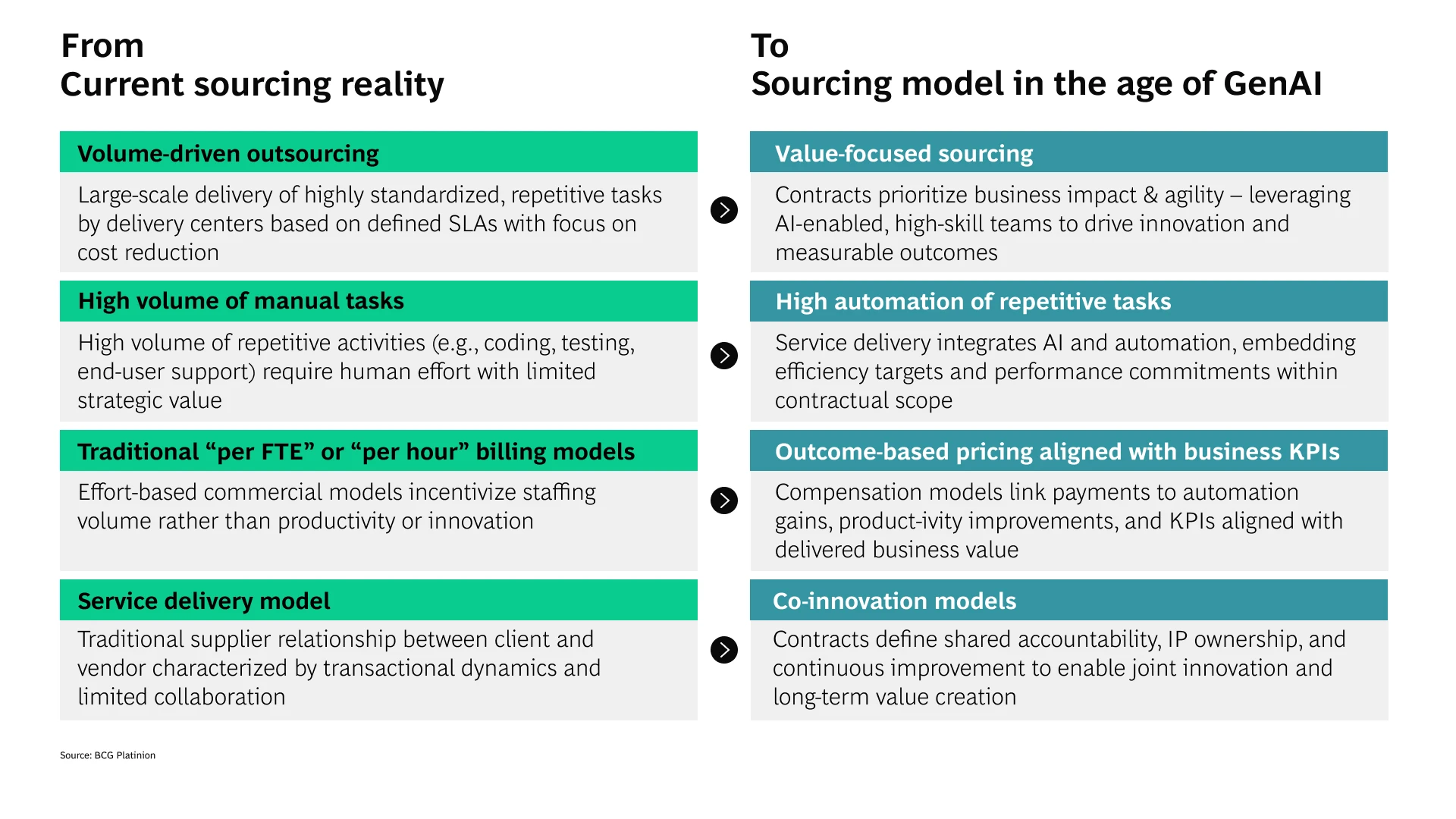
Top CIOs are taking bold steps to gain a competitive edge, recognising that this is an opportunity to develop integrated partnerships and build more agile, resilient delivery portfolios. There leaders understand that the future will be about skill arbitrage.
From Labor Arbitrage to Skill Arbitrage
Global delivery strategies have revolved around labor arbitrage for decades, whereby low-cost offshoring locations such as India and the Philippines provide the means to drive efficiency. As GenAI automates more repetitive and standardized tasks, the traditional labor arbitrage equation is losing relevance.
While routine software development and service desk activities are shrinking, the demand for high-value AI capabilities is skyrocketing. The ability to design, operate, and scale agentic AI systems, develop enterprise-grade orchestration frameworks, and integrate GenAI solutions into complex, legacy IT landscapes are all prime examples.
In response to this shift, we are seeing an uptick in European organizations moving away from cost-based offshoring in favour of near and onshore delivery hubs – ones aligned with both data protection and AI compliance requirements. Specialization and proximity to the business are becoming defining attributes.
The Onshore (and Nearshore) Advantage
Onshore AI hubs excel when GenAI use cases call for complex business integration, close oversight, and stringent data protection - particularly when proprietary and sensitive information is involved. These hubs also enable fast, transparent and trustful collaboration between cross-functional AI teams and business stakeholders.
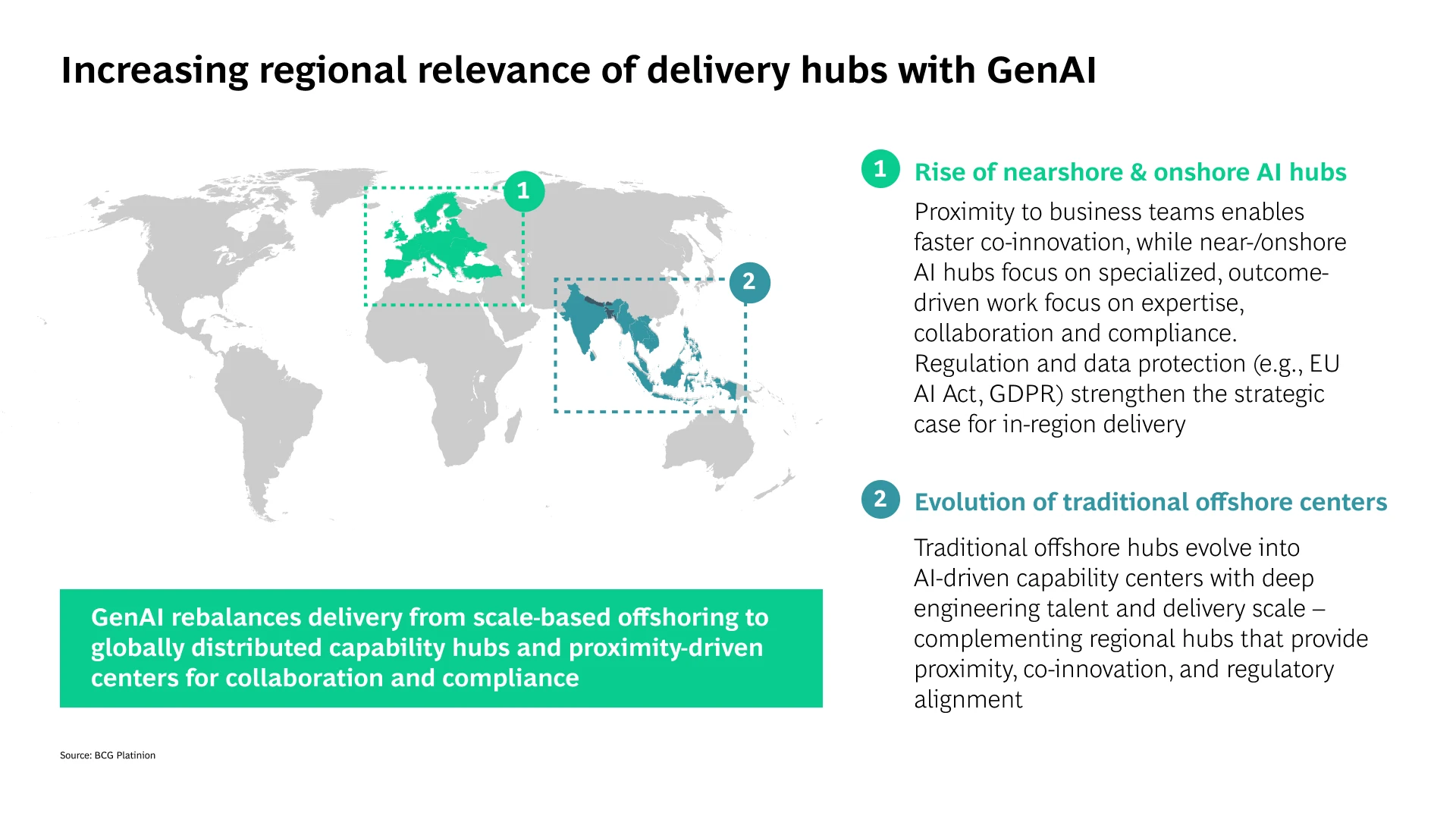
Eastern Europe has emerged as a leading nearshore region, with both strong AI ecosystems and regulatory frameworks in place – as well as access to deep AI talent. These capability centres are ideal for smaller, multidisciplinary teams co-located with business and data stakeholders.
Countries such as Portugal offer greater cost effectiveness relative to Western Europe, while still providing strong talent availability and regulatory compatibility. We are seeing shared-service hubs in such regions transform into AI Centres of Excellence, capable of supporting AI product engineering and complex model operations.
When it comes to traditional offshore centres, we can expect to see them repositioned away from frontline development (while remaining important at a foundational level). They will serve as hubs of deep engineering talent and delivery scale, but with a focus on global AI infrastructure, data pipelines, MLOps, and platform engineering.
Outcome-based Sourcing: A New AI Contract
From now on, outsourcing economics will be geared towards outcome-based models aligned with business KPIs – leaving behind FTE-based contracts. Co-innovation models and automation incentives are core features of these new economics, as organizations strive to deliver better outcomes more intelligently.
Model performance, feature velocity, business impact, and reliability metrics will be the new markers of sourcing success, and suppliers will be rewarded for driving efficiency. AI use cases will increasingly be developed by joint, nimble teams that combine engineers, subject-matter experts, and data practitioners alike.
Together, CIOs and vendors will jointly determine the potential for automation, establish guardrails for GenAI adoption and set productivity targets. As a result, sourcing is no longer just an operational lever, but one that drives transformation.
To successfully re-envision operating and sourcing models through an AI lens, we believe there are six strategic questions CIOs need to consider:
- Workforce and Talent – What will help the internal IT workforce maximize business value and collaborate effectively with external partners in the AI era?
- Performance Management – How can external partners be incentivized in the future to provide high-quality services?
- Location Strategy – Which offshore delivery centres are still strategic, and what must be done to rebalance our approach towards European AI hubs?
- Governance and Compliance – How can we ensure compliance with evolving European AI regulations while maintaining control of data and AI models?
- Supplier Portfolio – How do we renegotiate existing FTE-heavy, volume-driven outsourcing deals?
- Vendor Collaboration – How can we effectively integrate AI talent hubs into the existing IT organization?
Human Creativity Meets Machine Intelligence
CIOs that successfully transform their organization’s sourcing models will blend human creativity and domain knowledge with machine intelligence – resulting in IT functions that are significantly smaller, smarter, and more resilient.
The gap between early movers and hesitant organisations is widening across capabilities, cost position, and innovation speed. CIOs that proactively redesign their sourcing models for the GenAI era will be equipped for sustained value creation, especially when they are anchored by nearshore and onshore hubs.
At BCG Platinion, we help clients redesign their sourcing strategies to stay ahead of the AI curve – shaping future-proof IT ecosystems built for agility, compliance, and lasting business impact.