This is a draft version! Do not share the link externally!
TEST INS

Key Takeaways
ggggg

test test test
BCG Platinion asks
adesso responds
adesso positions its insurance offering around the in|sure Ecosphere, a modular insurance platform architecture that combines core insurance functionality with surrounding services and products. The platform covers P&C, life, and health as well as cross-functional capabilities such as partner management, commission, in-/ex-casso, and workflow. Core modules can be deployed together within the Ecosphere or integrated individually into an existing application landscape via standard interfaces and REST APIs.
Around this core, adesso combines additional components such as Fraud Management, Input Management, adesso GPT, and br.AI.n, alongside partner solutions and surrounding services. adesso presents this as an open ecosystem model rather than a closed monolithic core. The company states that its products are used by more than 50 insurers across P&C, life, and health in the German market.
adesso supports three operating models: on-premises / private cloud, hybrid, and SaaS. In the SaaS model, adesso operates the platform itself on a leading hyperscaler infrastructure; in hybrid setups, responsibilities are shared between adesso and the customer; and in on-premises or private-cloud models, customers operate individual or integrated adesso products themselves with flexible support from adesso. The company describes the platform as highly modular, cloud-enabled, AI-ready, and compliance-by-design.
BCG Platinion asks
adesso responds
In the in|sure Ecosphere, Agentic AI is not designed as a stand-alone add-on, but as a deeply embedded (Gen)AI Layer. Ecosphere forms the transactional backbone, while the (Gen)AI Layer acts as the orchestration layer that securely integrates AI agents into autonomous core processes and enables explainable automation of complex business processes.
We apply Agentic AI in three main areas:
- Claims processing — This is currently the primary focus, as it offers the greatest potential to reduce operating costs. adesso combines a fully automated, AI-supported claims management solution with an external partner, which is expected to improve the combined ratio by up to 4%, with adesso Fraud Management (AFM), an AI-based fraud detection solution that assesses claims in real time and flags suspicious cases automatically.
- Input management and customer service — Because input management is the central intake channel for customer enquiries, adesso uses AI to process unstructured information in real time, classify it, and route it into the relevant follow-up processes. This is supported by AIM, adesso's proprietary AI-powered input management solution.
- Underwriting and pricing — The architecture supports the integration of specialized predictive AI models for real-time risk assessment and pricing. Analytical agents can evaluate historical data and enable automated usage-based premium adjustments.
Overall, adesso positions Ecosphere as an open, agnostic platform: Ecosphere's Agentic AI layer provides the native orchestration, while insurers can integrate third-party or proprietary AI solutions at any time and retain full digital sovereignty.
BCG Platinion asks
adesso responds
In the in|sure Ecosphere, Agentic AI is controlled via the deeply embedded Agentic Layer (br.AI.n), which orchestrates autonomous core processes across lines of business. The most concrete production-ready use cases today are concentrated in claims and input management.
In claims, adesso combines automated claims handling via an external partner omni:us with adesso Fraud Management (AFM) for real-time fraud detection and case flagging. adesso also points to customer-facing assistance scenarios such as Digital Roadside Assistance, where a virtual agent supports hotline intake, verifies contract data against the core system, and guides the service process more efficiently.
BCG Platinion asks
adesso responds
We do not force customers into a closed solution. Ecosphere is radically open to third-party systems. Our Ecosphere Agentic Layer offers enormous procedural advantages as a native orchestration layer, yet customers can decide at any time to seamlessly integrate their own AI solutions to maintain their full digital sovereignty. Ecosphere's USP lies, on the one hand, in its agnostic approach to the use of AI (and general openness to the integration of third-party services) and, on the other, in the use of pre-built modules that adesso already provides fully integrated.
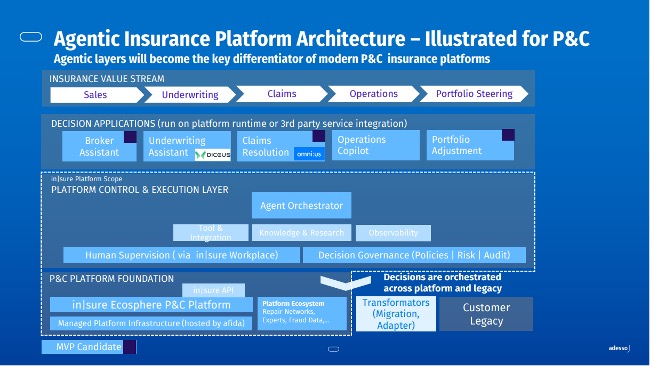
The highlighted MVP candidates represent early-stage solution areas currently being refined in specific customer environments. Of the three, Claims Resolution is closest to productive maturity, while Underwriting Assistant and Broker Assistant remain exploratory.
adesso's current focus is on AI applications along the claims chain for P&C insurers, which the company positions as its most advanced and productization-ready area today, especially from triage through fraud detection. In addition, adesso is developing document-based contextualization capabilities to extract relevant information from contract documents and DMS content for business processes. A broker assistant is a further application area currently being pursued with interested insurers. More broadly, adesso positions these applications within an ecosystem of agents that can also incorporate third-party solutions.
adesso positions the Agentic AI layer as a separate intelligence and orchestration layer on top of the transactional core, while the core itself remains a deterministic transaction engine for regulatory and operational reasons. The company currently builds this layer on a leading hyperscaler infrastructure and leverages managed foundation model services to integrate and operate AI models, with a strong focus on compliance and governance capabilities. For agent development, adesso favors open-source orchestration frameworks over deep reliance on proprietary model-provider SDKs. The resulting setup combines a cloud-centered infrastructure approach with an open and flexible orchestration and agent tooling architecture.
Relevant data sources include core transactional data, claims and risk data, contract and document data, and additional external signals where needed to identify emerging accumulations and spikes. adesso links its AI use cases increasingly to data-platform capabilities, particularly where insurers need to correlate risks, claims, and pricing signals more dynamically than in traditional retrospective portfolio steering. In this context, the company points to portfolio-oriented data solutions that support near-real-time views on risk and claims developments, with the aim of deriving pricing and steering impulses earlier in the process. At the same time, adesso describes this area as still evolving, with further extension of the solution set under consideration.
adesso sees the core transaction layer as the stable system of record that must provide the necessary transactional capabilities and interfaces, while the agentic and orchestration layers are built around it. The AI architecture is designed to work with adesso's own systems as well as with existing customer environments, so that insurers can roll out individual solutions without a full functional or data migration. End-to-end implementation therefore requires integration between the core, existing surrounding customer systems, and the surrounding agentic layer rather than a fully closed proprietary stack.
adesso currently deploys its platform on a leading hyperscaler infrastructure and builds its AI-related architecture around managed foundation model services. The broader operating setup includes additional third-party tooling for compliance, observability, execution, and token metering. Overall, the current cloud setup is centered on a primary hyperscaler for both platform and AI infrastructure, while technical deployment across other hosting environments remains possible.
adesso sees the future insurance core as a stable transactional and regulatory backbone that remains responsible for core processing, compliance, and the economic logic of the insurer, while agentic capabilities develop around it as an additional architectural layer. In this view, the core must be able to expose and support these capabilities, but the “agentic” logic, customer interaction, and surrounding ecosystem services will increasingly sit outside the core itself. At the same time, adesso expects the role of the core platform to become more relevant, not less, because it remains the part of the architecture that secures regulatory requirements, processes, calculation logic, and ultimately the insurer's license to operate. More broadly, adesso frames the future as an ecosystem model in which the core platform is one part of a wider network of agents and partner services, but the decisive part for regulated execution and scalable value creation.
BCG Platinion asks
adesso responds
Agentic AI as a survival factor
The era of isolated chatbot experiments is over. adesso positions Agentic AI as the next competitive standard: AI that not only supports users, but intervenes autonomously in core insurance processes. In this view, simply adding AI to legacy monoliths will not be sufficient. Instead, core systems need to evolve into open ecosystems that can integrate and scale agentic capabilities.
adesso's answer to this is the in|sure Ecosphere. It acts as the transactional backbone, providing regulatory structure and process logic, while the native Agentic Layer br.AI.n orchestrates autonomous AI processes. This layer follows a best-of-breed approach: insurers can integrate whichever AI solutions create the most value for their use case, whether partner solutions such as omni:us or their own proprietary models. adesso argues that this architecture is designed to create measurable ROI rather than isolated proofs of concept. In claims processing, for example, the company cites a combined-ratio improvement of more than 4% through omni:us, while the claims handler increasingly takes on a supervisory role over AI-supported processes.
BCG Platinion asks
adesso responds
adesso sees AI as the future operating model of insurance and aims to transform the in|sure Ecosphere into a more flexible, AI-enabled ecosystem. Strategically, the focus is on expanding AI layers such as br.AI.n, strengthening orchestration across applications and processes, and enabling best-of-breed integration of native, partner, and customer-provided AI solutions. In adesso's view, the degree of automation across insurance processes will continue to rise, while remaining bounded by regulatory requirements and customer-specific constraints. This positions the near-term strategy less as the launch of isolated new modules and more as the systematic evolution of the core platform toward scalable, sovereign, and increasingly autonomous AI-enabled operations.
BCG Platinion asks
.msg responds
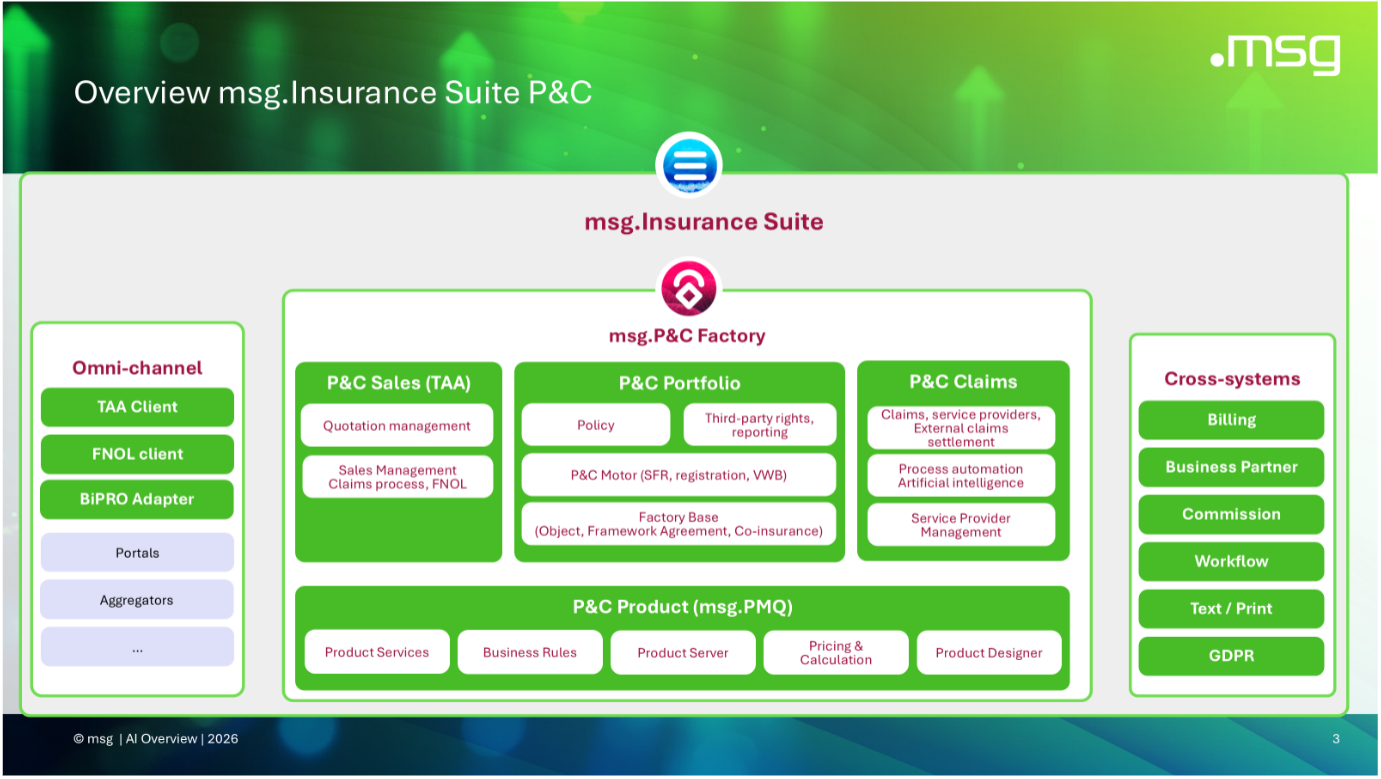
Our core insurance platforms are the msg.Insurance Suite — the broader insurance platform — and the msg.P&C Factory, which focuses specifically on policy administration and claims in P&C. AI capabilities are deeply embedded in these core systems and support key value-creation processes across the insurance value chain.
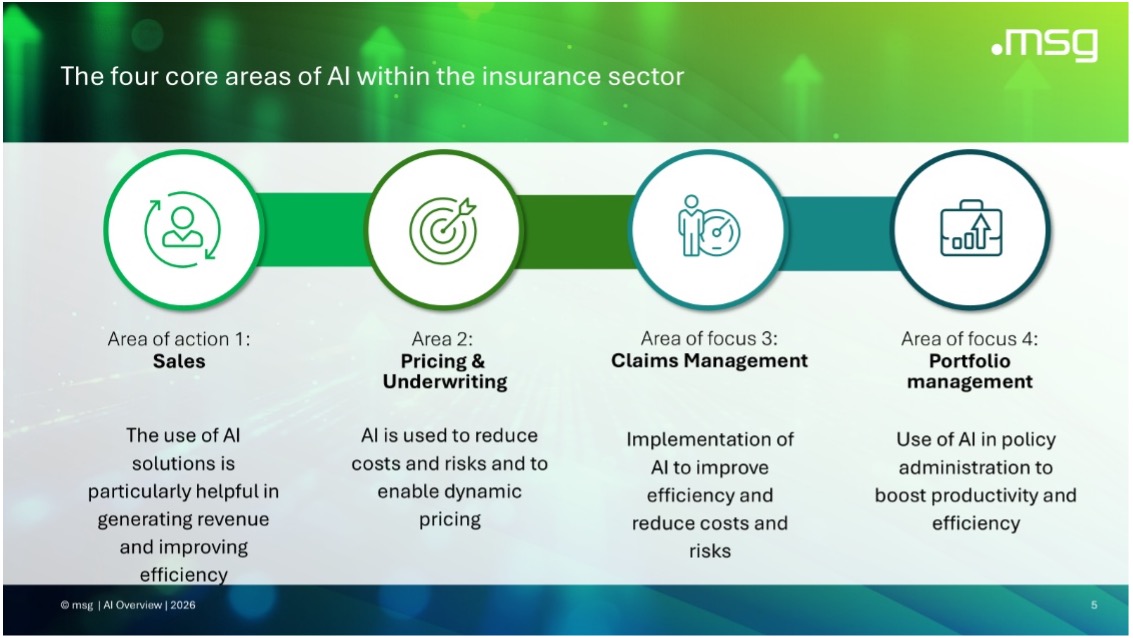
Focus areas include sales, pricing and underwriting, claims management, and policy administration. The Insurance Suite provides basic functions like policy information via chatbot or email bot, and automated processing of change requests. It also offers end-to-end handling of broker submissions (commercial lines), extraction and classification of documents, recognition of damage patterns using ML, and “Next Best Actions” for claims handlers.
We also position the msg.AI Platform / msg.Insurance Data Platform as the centralized data backbone for scalable, governed AI use.
BCG Platinion asks
.msg responds
We provide Agentic AI and AI-supported capabilities across the insurance core, especially in sales, pricing and underwriting, claims management and policy administration.
In sales and underwriting, AI supports data completion, validation, and risk-related decision preparation. In claims, AI is used for document handling, pattern recognition, and decision support within workflows. In policy administration, AI helps automate servicing processes and broker-related workflows. In customer service, AI supports policy inquiries and standard communication through conversational channels.
More broadly, AI-supported workflows are already embedded in the msg.P&C Factory today (AI in a Process), while AI agents can also be deployed as individual sub-processes (AI as a Process). Productive AI agents in customer implementations include claim:it, process:it, and ask:it.
BCG Platinion asks
.msg responds
Our use of agents to deliver policy information via chatbot or email bot is production-ready, as is our AI-supported assistance capability for policy inquiries, the automated processing of change requests, end-to-end handling of broker submissions (commercial lines), and the extraction and classification of documents.
Other production-ready use cases involve the recognition of damage patterns via ML, early detection of cumulative losses, “Next Best Actions” for claims handlers, and the identification of recovery potential and consequential damages.
Automatic reserve setting, completion of application data, automatic plausibility checks, derivation of tariff attributes from unstructured data, and straight-through processing via ML rulesets are also production-ready use cases we offer.
BCG Platinion asks
.msg responds
Our AI-related offering combines deeply embedded AI in the core systems, ready-to-use productive agents, and a platform-based target architecture.
We emphasize seamless core integration across underwriting, claims, policy administration and customer service. AI-supported workflows are a core component of the msg.P&C Factory, and both the msg.AI Platform and msg.Insurance Data Platform serve as a centralized data lake (providing the foundations for scalable, governed AI use).
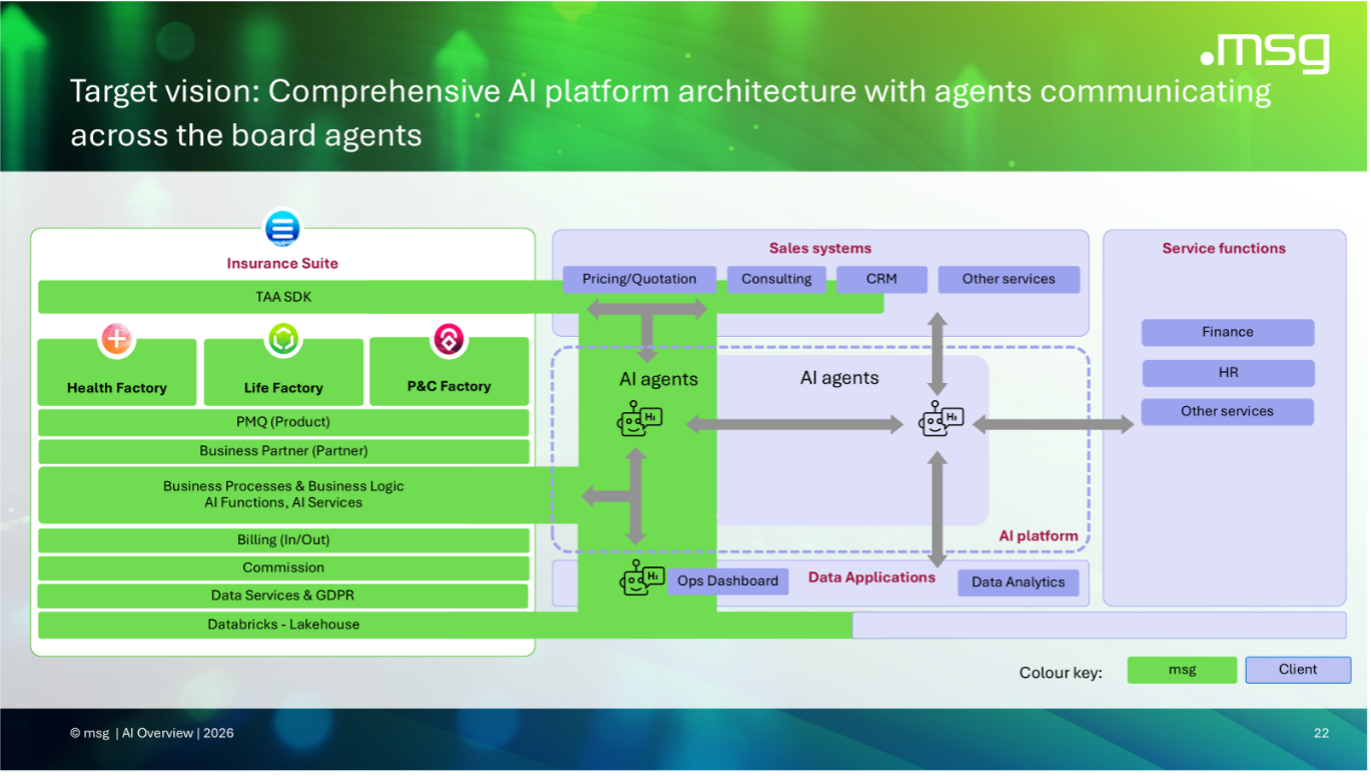
Our offering can be described as a platform approach with shared governance, reusable components, and centralized operation — designed with communicating agents in mind.
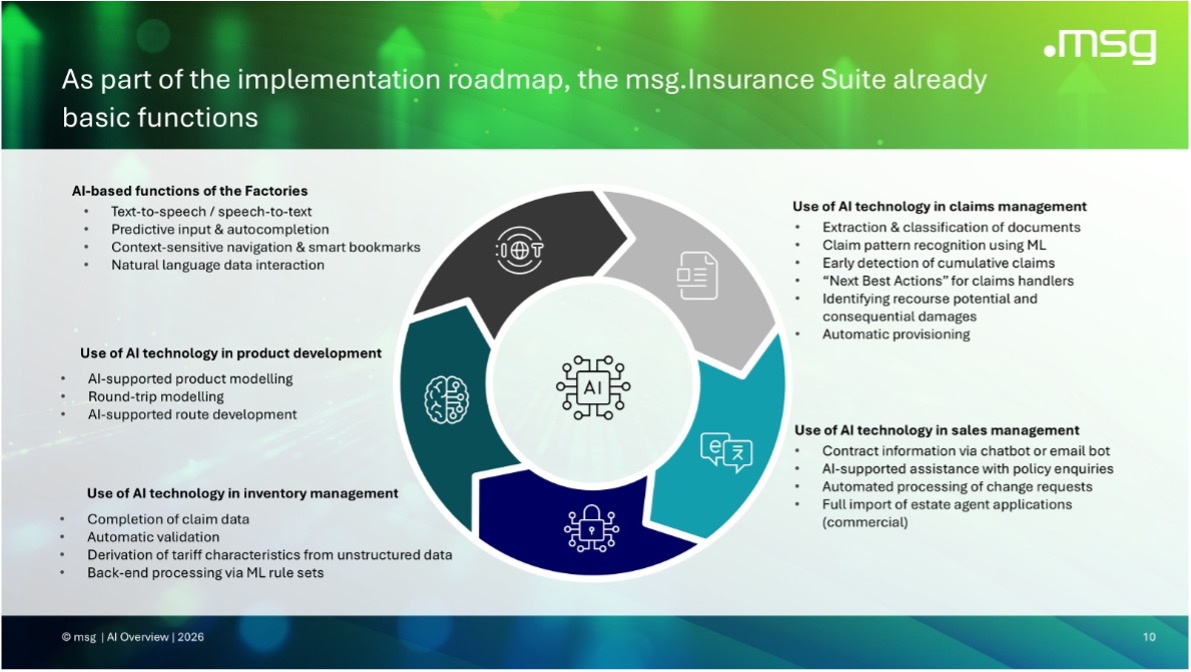
We already offer AI-based customer chat via the Process:it product. Customers can ask about contracts, make changes, and receive suggestions on how to optimize coverage or premiums. The same concept is planned for internal staff, so case workers can retrieve condensed information and trigger actions through chat (instead of navigating multiple screens). AI is also used in document intake and claims handling — documents are classified, analyzed, and routed into workflows.
When it comes to our claims solution, Claim:it, an agent checks information against product rules and LLM-based reasoning, and can process a claim in an almost fully autonomous way (with a human review before payout). Using image recognition, it also uses a forensic approach to flag potentially AI-generated fraud.
We develop our insurance agents in-house because generic tools do not fit our software, releases, and domain knowledge closely enough. We are LLM-agnostic, use our own prompt layer, and can work with whichever models the customer runs. Orchestration is handled by a workflow engine, while the data layer is managed through a dedicated analytics platform. Over time, we intend to create a multi-model platform with stronger governance and agent-to-agent communication via MCP.
Data from the msg suite streams into a real-time data service and combines it with other source systems — especially important for customers that must connect legacy and new core environments while still getting fast reporting and analytics. Our real-time data platform also feeds downstream reporting, warehouses, and AI agents. Our data dictionaries help map structures quickly and support reliable analytics and production use.
For true end-to-end use cases, we believe having a selective API layer around the suite is essential. The key idea is that AI creates value only when it is linked to workflows, rules, and follow-up processes, not as a stand-alone recognizer. With this in mind, we are pushing tighter integration between the API layer, AI layer, and process layer.
The cloud strategy is deliberately flexible. The SaaS solution is primarily deployed on a leading hyperscaler, while also supporting customer environments and enabling rapid deployment across other common cloud setups due to its containerized architecture. Stack:it Cloud is also a viable deployment option.
We do not expect AI to replace insurance core systems in the next three to five years. In our view, insurers still need the structure, governance, and regulatory reliability of a core platform.
AI will therefore sit as an additional architectural layer: the core provides the stable backbone, while agents enable more flexible and individualized interaction at the edge. Vendors must drive innovation proactively and help customers adopt AI in a controlled way. That includes enablement, change support, and practical AI building blocks for the customer layer.
Customers should also be able to connect their own agents above the protected core via MCP-based access; this is already established in life insurance and is now being extended into P&C.
BCG Platinion asks
.msg responds
The msg.Insurance Suite already provides basic AI functions as part of the implementation roadmap. The roadmap includes build-out elements such as AI-Workbench, AI Marketplace, Knowledge Management, Context-Engineering, domain-specific / universal / task agents, and a future architecture with communicating agents.
In software engineering, the roadmap includes:
- DoR agent — productive
- AI in coding — in use
- Requirements assistant — under expansion
- Test generation — under expansion
- Quality gate vision
We cannot yet specify public availability dates and module-by-module customer-value metrics such as STP uplift or cycle-time reduction.
BCG Platinion asks
.msg responds
Our strategic direction is to move away from single, embedded AI capabilities and productive agents, toward a holistic, governed platform approach. We explicitly contrast point solutions, system integration, and platform solutions — positioning the platform solution as the target for reusable components, centralized governance, and scalable operation.
The msg.AI Platform provides a unified, scalable architecture for orchestrating AI agents, enforcing governance and security standards, and enabling enterprise-wide automation.
BCG Platinion asks
Peak3 responds
We offer two core products: Graphene, an enterprise-grade, modular, cloud-native SaaS insurance core platform, and Fusion, an insurance sales and orchestration platform for scalable distribution models. Peak3 also provides a growing portfolio of agentic AI solutions.
Graphene supports all major lines of business on one platform, and its no-code product configurator enables rapid product development and iteration. Besides traditional insurance products, Graphene supports usage-based, parametric, and accumulator products — the platform covers the entire insurance value chain end-to-end.
Deployed as a cloud-native, cloud-agnostic SaaS platform, Graphene also offers flexible deployment options: (1) Regional public instance (Peak3-managed, multi-tenant public SaaS), (2) Private single/multi-tenant instance (Peak3-managed private SaaS), or (3) Private single/multi-tenant instance (client/partner-managed).
With full microservices architecture, Graphene supports end-to-end deployment or selective module implementation (e.g., replacing only the claims module).
Recognised by Celent XCelent 2025, IDC MarketScape Major Player 2025, and ISG Provider Lens Leader/Rising Star 2024.
BCG Platinion asks
Peak3 responds
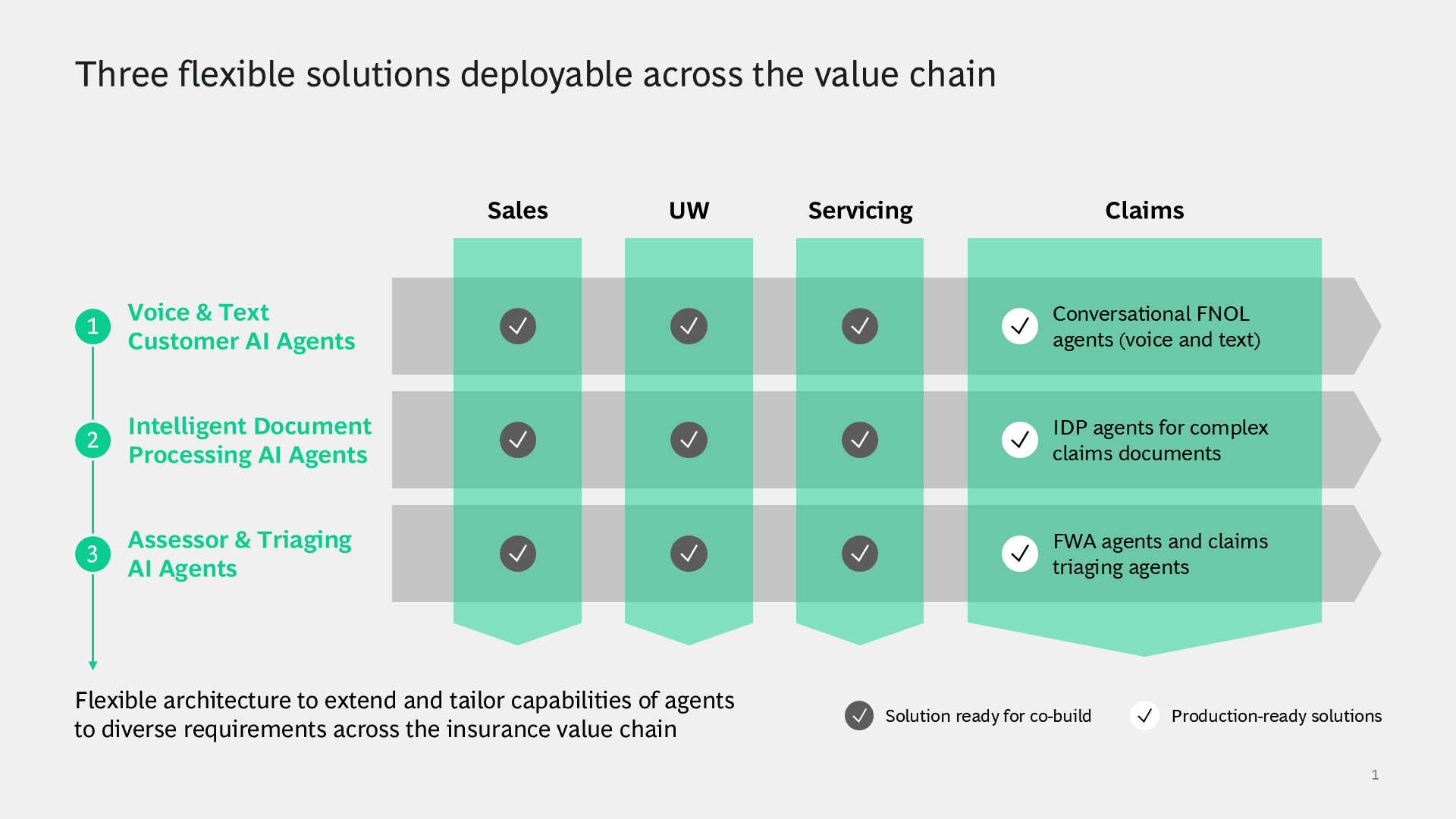
We build agentic AI solutions that can be deployed across the value chain using a twofold approach: pre-built AI agents that are production-ready and can be deployed quickly, and an AI orchestration platform that enables insurers to co-build and manage custom agents across the lifecycle.
Our AI agent build is focused on three categories that can be deployed across different parts of the value chain:
- Assessor and Triage Agents — to automate and improve decisions with AI agents that autonomously assess transactions, develop risk reports and scores with transparent evidence chains, and assist experts with final decisions
- Intelligent Document Processing Agents — to eliminate manual work and increase accuracy with vision-powered AI agents that intelligently recognize, extract data from, and automate the validation of documents
- Voice & Text Customer Agents — to manage, improve and automate customer interactions 24/7 through conversational multi-modal AI agents
BCG Platinion asks
Peak3 responds
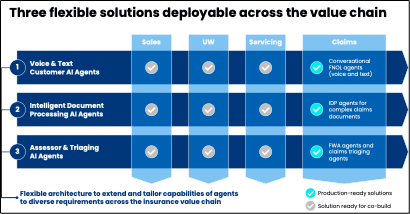
The following agentic AI use cases are production-ready and in implementation with clients today:
- Voice & Text Customer AI Agents
- Intelligent Document Processing (IDP) Agents
- AI Assessor & Triage Agents
Other solutions ready for production roll-out include voice AI telemarketing agents, compliance call agents, and collection agents. These are all designed as AI-driven outbound calls with human-like voice synthesis, multi-turn conversation capability, real-time intent analysis, and dynamic strategy adaptation.
BCG Platinion asks
Peak3 responds
- AI-native core integration: with a full microservices and open architecture, Graphene was designed from the ground up with AI readiness. We provide flexibility to clients to deploy AI within Peak3 solutions or externally, easily integrating via MCP.
- Standalone or integrated deployment of AI agents: we decouple our agentic AI applications from the Graphene core platform, allowing the deployment of our AI solutions on top of other core systems.
- LLM and cloud agnosticism with long-term optionality: we design to be agnostic of any specific LLM or cloud platform. Insurers control which underlying models — whether public or private — best fit their needs.
- Compliance-first architecture with full CI/CD lifecycle management: explainability, observability, and security are architected into every AI component. Evidence chains, confidence-level citations, human-in-the-loop governance, and strict guardrails ensure compliance.
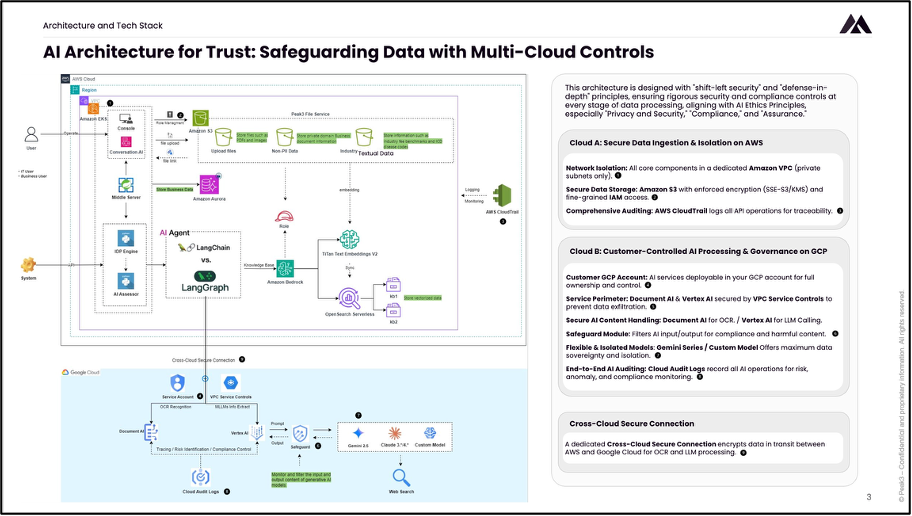
These solutions are designed to be multi-modal and support multi-languages. Clients can configure underlying capabilities to fit their needs on top of pre-defined capabilities (e.g., FWA rules to be applied in claims assessment).
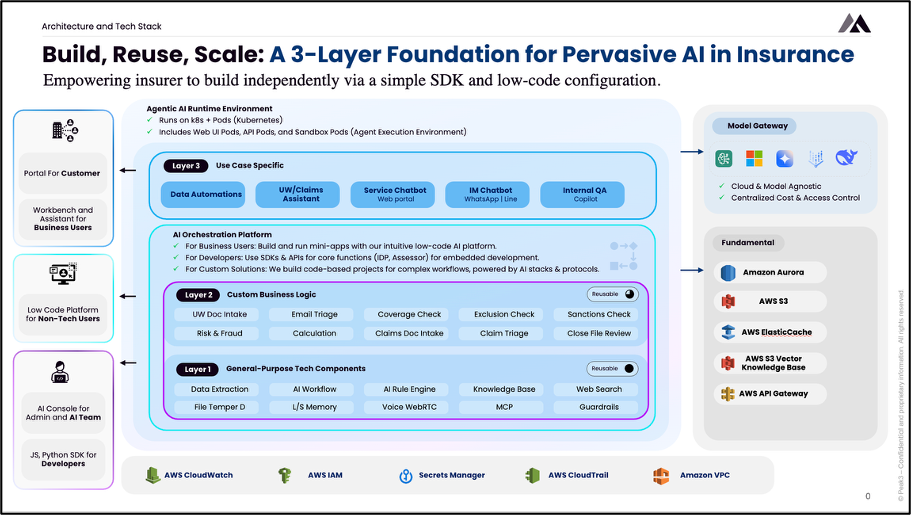
We design to be LLM-agnostic and support a multi-model framework. The architecture includes a Model Gateway that facilitates efficient management, routing, and load balancing across multiple foundational models. Insurers are in full control of selecting the underlying models — whether public or private — that best fit their regulatory, performance, and cost requirements.
Protocols and standards we support include: MCP (Model Context Protocol), A2A (Agent-to-Agent), Open APIs, webhooks, tool calling, and Server-Side Events (SSE) APIs for real-time streaming.
Key platform components include: Agent Management (centralized configuration and lifecycle management of AI agents), Agentic Workflow Engine (dynamic task orchestration guided by SOPs), RAG Pipeline (retrieval-augmented generation for knowledge management), LLM Operations (model management, fine-tuning, and performance monitoring), and a CI/CD + DevOps + LLMOps factory for enterprise-grade stability and observability in production environments.
Generally, if deployed within Graphene, no further data platform is required, but integration with external data sources (for data sitting outside of the core) may be needed.
Graphene provides built-in big data platform capabilities, including a Data Warehouse and Customer Data Platform (CDP). Real-time data synchronization and event streaming ensure AI agents operate on current information. Hot case caching supports low-latency decision-making. Third-party data APIs can be integrated for enrichment (e.g., external fraud databases, medical data services).
The platform enforces unified data access across functional modules with consistent identifiers, data quality standards, systematic data lineage, and ACID-compliant transactions.
Depending on the use case, further data may be needed, such as SOPs, rule libraries, policy terms, regulatory guidelines, fraud patterns, medical codes (ICD-10, CPT), FAQ listings, product specifications, and compliance guides — which are managed via RAG pipelines with vector databases for semantic retrieval.
Graphene is designed as an end-to-end core insurance platform, which means most required systems are already built-in or pre-integrated. Generally, any system that sits outside of a normal core application needs to be integrated with (e.g., scanning solutions for physical claims documents, telephony system for outbound AI calls, payment gateways, etc.).
Our cloud strategy is built on three principles: cloud-native, cloud-agnostic, and flexible deployment. Graphene is built entirely on microservices with containerized deployments. Generally, we deploy on public hyperscalers, but subject to availability of required services (including self-build) we also deploy on private and sovereign cloud.
The insurance core will continue to play an essential role. Business logic, rules, calculations, and regulatory compliance traditionally managed by core platforms cannot be fully absorbed into an agentic AI application layer. The core provides the deterministic, auditable, efficient and compliant transactional backbone that insurers require.
However, the core must evolve from a passive system-of-record into an “intelligent core” — an AI-ready platform that serves as the foundation for agentic operations. This means agentic AI operating as an orchestration and intelligence layer on top of the core, augmenting and automating workflows while the core retains business logic, data integrity, and compliance governance.
The core exposes its functionality comprehensively through APIs and modern protocols (MCP) so AI agents can seamlessly interact with all modules. While AI in the core can be delivered as an integrated experience, we believe it should be architecturally separated.
BCG Platinion asks
Peak3 responds
Our agentic AI roadmap for this year includes the following phases:
- Available now and continuous enhancements in Q2: Agentic Claims — end-to-end AI-powered claims processing including FNOL chatbots, IDP, AI assessor/FWA, and claims assistant with HITL
- Q2/3: Expanded AI Orchestration Platform capabilities — enhanced agent lifecycle management, broader MCP/A2A integration library
- Q3: Agentic Underwriting — AI-assisted risk assessment, automated data gathering, and underwriting decision support
- Q3/4: AI telemarketing and agents (as well as other customer facing agentic applications)
We expect to release agentic configuration of backend capabilities within H2 (currently POC stage).
BCG Platinion asks
Peak3 responds
Our focus is on deepening and scaling pre-build AI agents: Expand the portfolio of production-ready AI agents from claims (where we have the deepest capabilities today) into underwriting and sales, while continuously enhance existing modules (IDP, FWA, voice/text agents).
Importantly, we don't want to build in a vacuum and are co-building with customers before productizing solutions. We want to continue a strategy of long-term optionality for clients, supporting all deployment and model options (incl. Sovereign AI).