This is a draft version! Do not share the link externally!
Forecourt Formats of the Future: Tech-fueled Retail Success

How fuel retailers can tap into new revenue pools with differentiated forecourt formats and the technology architecture built to scale them.

Underscoring the importance of ‘beyond the pump’ services for fuel retailers going forward, convenience stores accounted for 35% of average store sales in the U.S. in 2025, generating ~60%1 of gross profit. But potential differs across the network.
The first primary dimension for format selection is fuel and charging demand, the second is retail attractiveness. Specific site economics then determine viable approach, or whether a location should remain in the network at all. Customer missions and location characteristics need to be assessed as part of this process.
Broad location labels such as ‘motorway’ or ‘urban’, once used to determine a site’s role, are no longer sufficient going forward. The network will increasingly become a portfolio of differentiated formats, each requiring a bespoke capability mix and level of technology support. Managing this shift successfully calls for a single, common reference architecture.
The Four Formats
Low-cost essential coverage maintains network coverage through a low operating-cost model. Rural dealer sites, and locations retained to serve fleet and fuel-card customers, tend to fall into this bracket – where demand and non-fuel potential are limited. Operating models are lean and fuel is the core offer, supplemented with vending or grab-and-go where relevant.
Quick fuel and out prioritizes speed and throughput as opposed to customer dwell time, leading with fuel and featuring targeted retail and simple conveniences. Options like ‘pay at the pump’ are available to keep customer journeys as frictionless as possible.
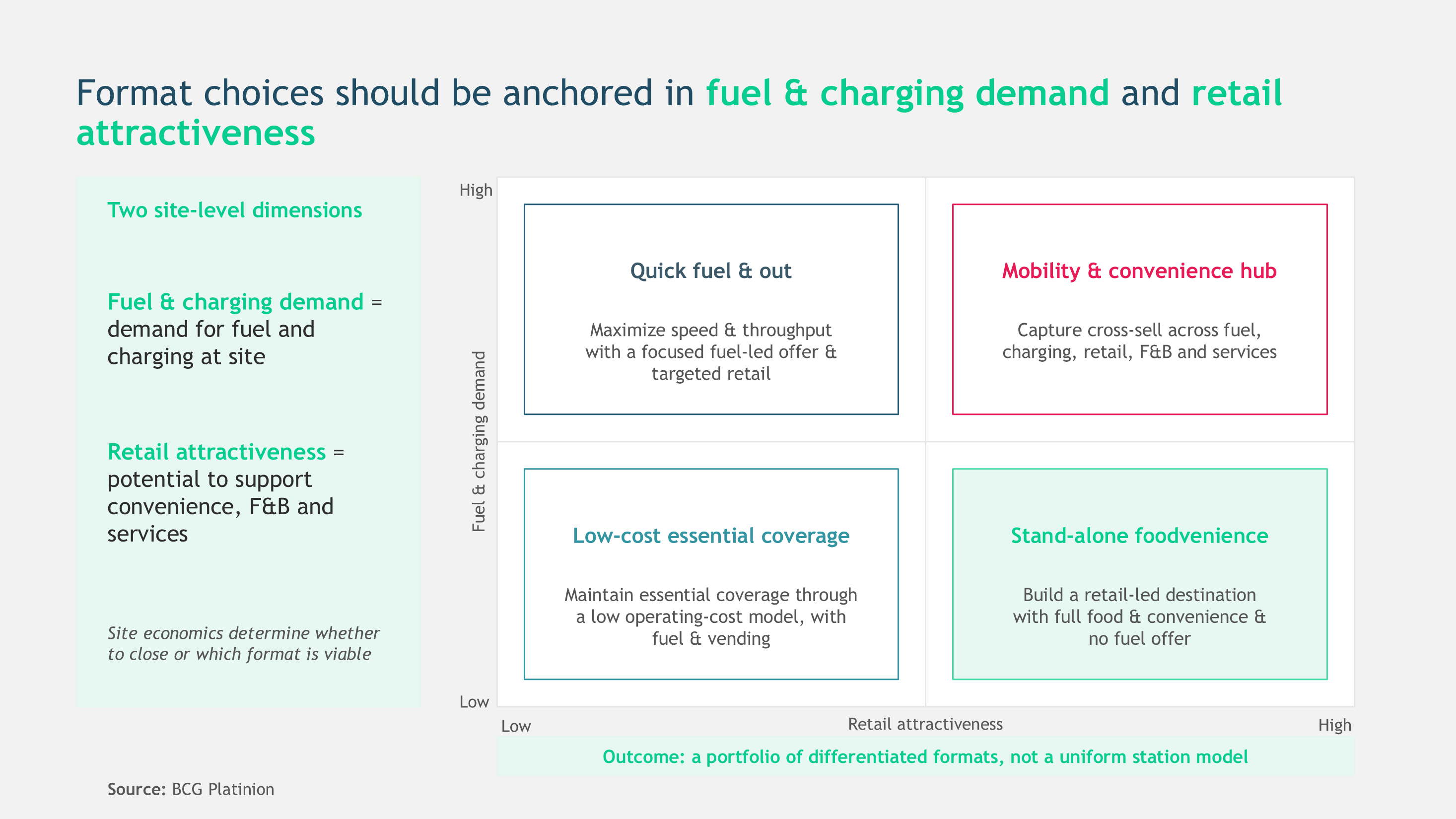
Mobility and convenience hubs are a multi-service, customer-centric forecourt model, combining fuel and charging with a broader convenience offer. This proposition encourages customers to make greater use of the site, and calls for greater integration across forecourt, retail, foodservice, and mobility operations.
Stand-alone foodvenience is a retail-led format with no fuel offer. It is suited to locations with sufficient retail attractiveness to support a fuller convenience and food proposition. EV charging may complement the offer in instances where site economics support it, but it is not a defining requirement.
Sites retained for essential coverage should receive targeted investment to sustain that role and to improve operating efficiency (as opposed to replicating a hub proposition). Locations with the throughput, real-estate characteristics, and retail potential to support the broader proposition should have capital allocated to them accordingly.
Matching Formats and Technology Intensity
The technology model should reflect the proposition, operating model, and economics of the site. For instance, low-cost essential coverage sites rely on focused fuel cores and lean, automated operations. At the same time, they only require minimal supporting capabilities like payments, fleet loyalty, and vending (EV charging should be considered selectively where local demand and site economics justify it).
When it comes to quick fuel and out models, they too depend on strong fuel cores while requiring only lightweight retail and customer functionality. Data-driven pump pricing, including AI-based optimization where justified, may be a priority even where the convenience offer is limited. Throughput and margins are key, and EV charging may not be present in all cases.
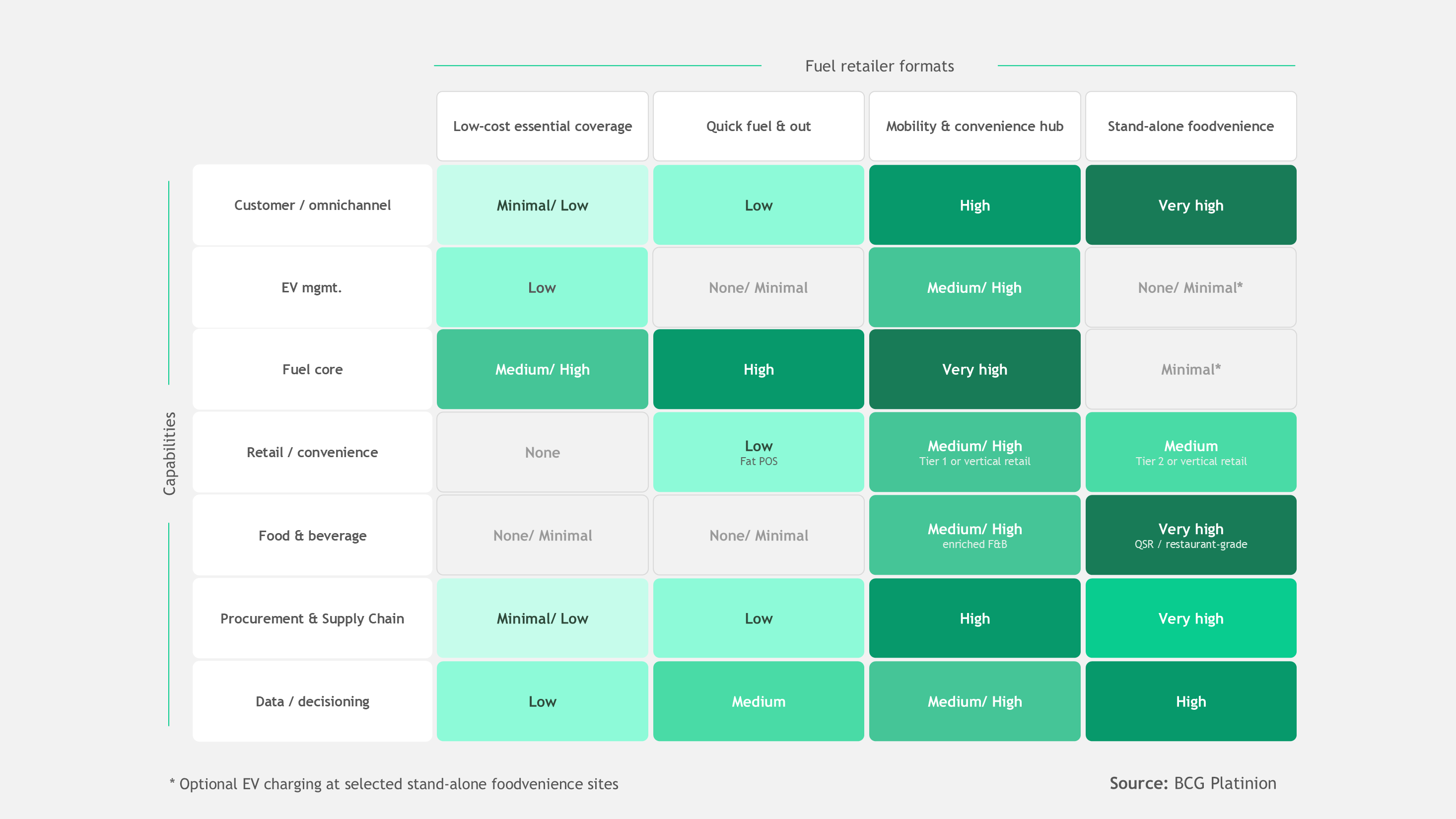
Mobility and convenience hubs require a broad and deep capability mix, including real-time integration in cases where services require it. These sites span retail, F&B, customer, supply chain, and site operations – EVs will also need to be considered as adoption and fast-charging infrastructure expand.
The technology focus shifts more heavily toward retail, F&B, and operating capabilities when it comes to stand-alone foodvenience. Instead of mobility infrastructure, the priority is retail execution, customer engagement, and store-level productivity. Tech investment is concentrated on enabling differentiated food-led convenience propositions, and that means integrated POS, digital ordering, inventory management, demand forecasting, replenishment, loyalty, and customer analytics.
Managing many different sets of tailored technology requirements for different formats across a network calls for a common architecture, one with the foundations and interoperability to support various capability mixes and levels of technology intensity.
A common architecture with specialized capabilities
It is increasingly recommended that industry-leaders adopt a shared data and decisioning layer that spans fuel pricing, merchandise, promotions, and quick-service restaurant operations.
To do this, they will need to combine common data foundations with domain-specific analytics and decisioning – this is so that each format can use the capabilities relevant to its proposition without duplicating the underlying platform.
Crucially, a common reference architecture needs to be able to reuse existing components that are still effective, and add dedicated functionality where necessary. This is the first of three key architecture tips:
- Preserve what remains fit for purpose. Fuel and charging capabilities, like pricing, forecourt operations, inventory, and regulated processes, can remain on the current core where existing systems are effective. Corporate and support functions can also reuse enterprise capabilities where appropriate.
- Specialize where retail and F&B require dedicated processes and functionality. This includes capabilities such as store operations, assortment management, and food-specific operations. Specialization does not necessarily require a new platform; enterprise components may be reused and reconfigured for retail procurement and forecasting (where they meet the functional requirements).
- Converge where requirements align across formats. Identity, loyalty, catalogue, promotions, and customer data can be shared across fuel, retail, and F&B. Commerce and order-management capabilities can also be shared where process requirements are sufficiently similar. Common customer, commerce, and data foundations can support coordinated services like order-ahead
Some procurement and supply chain capabilities can be shared across formats, such as planning and data. But examples like product sourcing, stock management, and food supply need to be tailored to each format – fuel supply is managed separately.
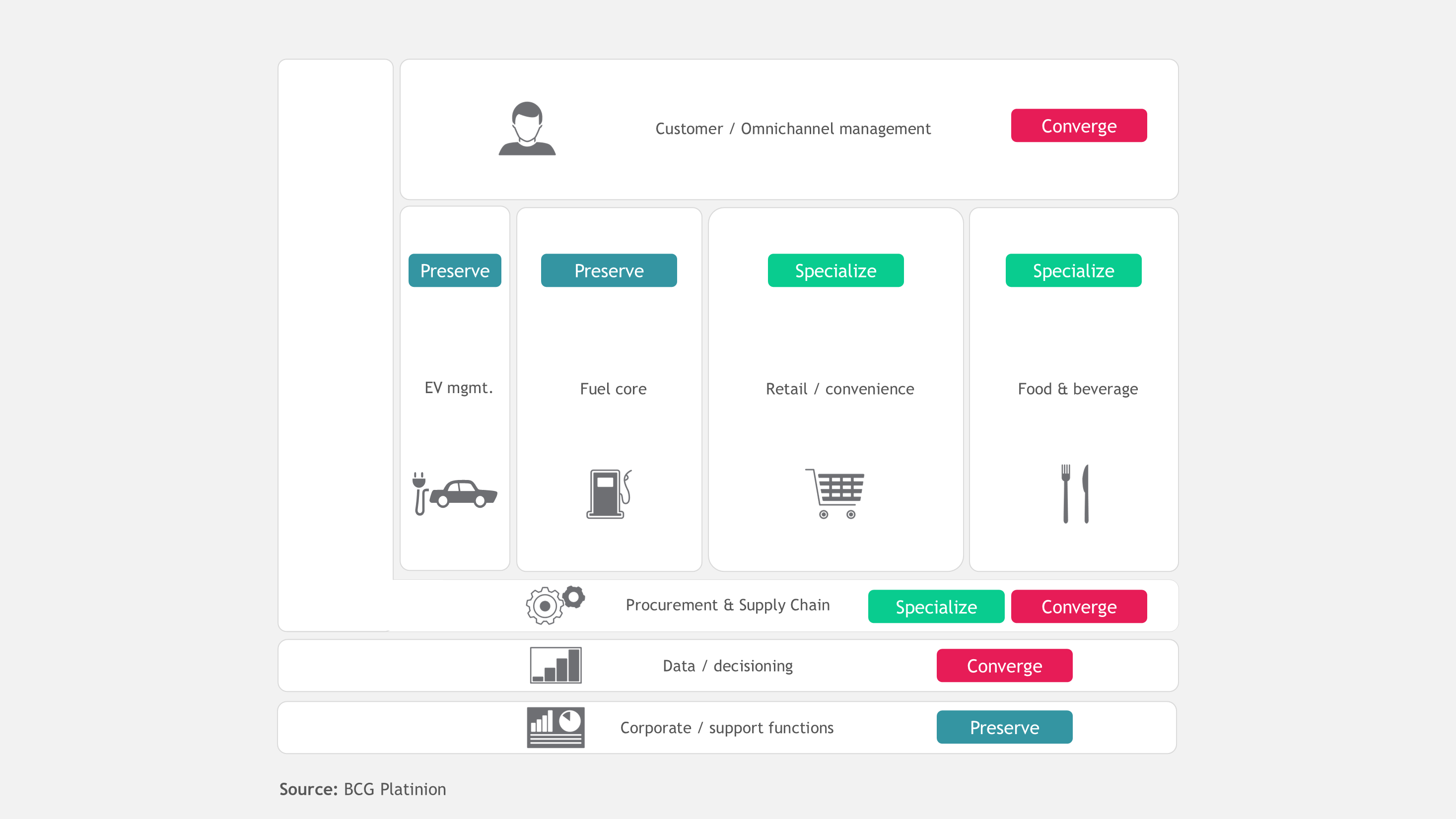
The goal is a common backbone that enables format-specific capabilities to be introduced where they are needed. Technology choices should be guided by the principles outlined in Exhibit 3, with existing components and new platforms assessed based on functional fit, integration requirements, scalability, and cost.
Take the Journey mile-by-mile
Once the target architecture is clear and the destination is set, retailers need to take an incremental approach and decide what to address first.
Capabilities that support several formats can be addressed early, particularly shared customer, data, and integration foundations. A common customer model, consistent data structures, and reusable integration services can provide a base across the network.
Retrofitting these foundations once multiple vertical platforms are in place risks increased integration effort, fragmentation, and rework. Retailers should build the minimum shared foundations alongside priority use cases, adding specialized retail and F&B capabilities as propositions and business cases mature.
Investment sequencing should reflect how the network, and its format mix, are expected to evolve. This technology roadmap should move in step with the business roadmap, balancing the reuse of existing components with the scalability and integration requirements of the target landscape.
Five questions to help guide format and technology choices:
- Which sites should become growth platforms, which should be retained for essential coverage, and which no longer have a role in the network?
- Which mix of formats best fits fuel and charging demand, retail attractiveness, and site economics across the network?
- Which capabilities should remain shared, which should be specialized by format, and where can convergence create value?
- Which technology components can be reused or improved, where are new platforms required, and how should investments be sequenced?
- Which business and operating assumptions should be validated before broader rollout?
Measures such as non-fuel conversion, margin per visit, service time, and waste can be useful when validating assumptions, assessing performance, deciding where to scale, and figuring out how fast to move in each case.
To continue the conversation, be sure to contact our experts!
Footnote:
1: National Association of Convenience Stores (NACS), 2025 data presented at the 2026 State of the Industry Summit; Chrissy Blasinsky, “In-Store Sales Drive Growth,” NACS Magazine, June 2026.